

If you’re running Meta ads for an HVAC or plumbing company and haven’t tried home age targeting, there’s a reasonable chance you’re paying to reach people who rent.
Not because your targeting is careless. Because Meta has no way of knowing whether the person seeing your ad owns the property they live in, and the interest-based workarounds most agencies use don’t change that. They just make the problem harder to see in the data.
This article covers a different approach: importing property-level data, year the home was built, heat type, AC type, into Meta as a custom audience. It’s not a guaranteed improvement over what you’re already running. It’s a layer worth testing, and most advertisers in this space haven’t tried it.
Why Native Homeowner Targeting Is Gone and What Replaced It
Before 2018, you could target “Homeowners” directly on Facebook. The option was powered by data providers, Oracle, Acxiom, Experian, who had spent decades compiling property records. One checkbox, verified homeowners, done.
Cambridge Analytica ended that. Facebook’s response was to strip Partner Categories entirely, roughly half its ~1,200 targeting criteria gone, including homeownership status, third-party income signals, and most other attributes home services advertisers had quietly relied on for years.
What replaced it was native targeting: interests, behaviors, demographics. For home services, that means interest stacking — people who follow home improvement pages, engage with Lowe’s content, watch HGTV, or show a “recently moved” signal. None of those confirm ownership. A renter decorating their first apartment looks identical to a homeowner considering a $9,000 HVAC replacement from Meta’s perspective.
Advantage+ doesn’t resolve this. It’s genuinely good at finding buyers at scale when given strong signals, but it optimizes on behavior, not on whether someone owns the house they live in. If your best leads happen to share behavioral patterns with non-homeowners, Advantage+ has no mechanism to sort them.
Most home services advertisers accepted this as the new reality and moved on. The alternative exists, it just requires one more step.
The Property Attributes That Actually Predict a Job
For home services, the most predictive targeting signals aren’t just about the person. They’re about the house.
Year the home was built is the highest-signal attribute for HVAC replacement. ENERGY STAR advises considering replacement for air conditioners and heat pumps over 10 years old, and furnaces over 15. A home built before 2005 has a system at or past its expected service life, regardless of who lives there, what they earn, or what they’ve clicked on recently. The house tells you. The person doesn’t have to.
Home heat type determines the job you’re pitching. Gas heat means a forced-air system, a specific replacement scope and a message around efficiency and energy bills. Heat Pumps are a different equipment profile entirely, often a different price point, and creative that works for one will miss on the other. Splitting them into separate audiences is worth the extra setup.
Air conditioning type narrows it further. Central AC is the residential replacement target. Anything else is the wrong audience for a residential HVAC company.
New movers deserve their own campaign. Homeowners in their first year are evaluating every service vendor with no prior loyalty and a list of things the house needs. High-intent, accessible, and open.
On credit score: Meta restricted custom audiences using financial status indicators (including credit score) as of September 2025. Income filters accomplish similar qualification and remain available. Use income where you would have used credit.
The Same Logic Applies Across Trades
Home age targeting isn’t an HVAC-only play. Construction era predicts trade-specific problems with real precision.
Plumbing – homes built 1978 to 1995: Polybutylene pipe was installed in an estimated 6 to 10 million U.S. homes during this period. It degrades when exposed to chlorine in municipal water, failing from the inside out with no visible warning. It hasn’t been used in new construction since 1995. A plumber targeting single-family homes built in that window is reaching properties with a known pipe failure risk — many still original.
Electrical – homes built 1965 to 1973: A copper shortage pushed builders to substitute aluminum wiring in roughly two million homes. The CPSC found those homes are 55 times more likely to reach fire hazard conditions at connections than copper-wired homes. Many insurers charge meaningfully higher premiums or decline coverage entirely until it’s addressed — a resale and insurance problem the homeowner may not fully grasp yet.
In all three cases, the targeting logic is identical: the construction era of the house predicts the job more reliably than anything Meta knows about the person who lives there. The date ranges just change by trade.
Matching the Audience to the Offer
The right qualification level depends on the offer, not just the trade.
For a replacement installation, a $9,000+ job, tight filters make sense: older homes, single-family, central AC, income qualifiers. The ad is irrelevant to someone in a three-year-old house, and irrelevant ads cost money.
For a maintenance special or tune-up, the case for tight filtering is less clear. Every homeowner with central AC needs routine maintenance. Whether a property-qualified audience outperforms a broader one at lower CPL is worth testing, the answer varies by market.
How Home Age Targeting Works on Meta
Home age, heat type, and AC type have sat in data aggregator databases for decades — compiled from property records, utility data, and other offline sources by companies whose business is building and maintaining that infrastructure. What’s been missing is a self-serve path to activate it inside Meta.
That path exists through tools like Deep Sync One.
Deep Sync maintains an identity graph of 260 million U.S. consumers with approximately 97% residential address coverage. It links offline records, addresses, property data… to digital identifiers: emails, device IDs, mobile ad IDs. When you filter for homes built before 2005 with central AC, gas heat, and household income above $50K, Deep Sync resolves those filters to people, matches them to their Meta profiles, and delivers the result as a custom audience directly to your ad account.
It arrives and behaves like any other custom audience, targeting, exclusions, lookalike seed. The only difference is what it’s built from.
- Create a free account at one.deepsync.com using a business email
- Navigate to Destinations → Add destination → Facebook → enter your Meta Ad Account ID
- Open Audience Builder and add your filters: heat type, AC type, income threshold, year built range, service area geography
- Review the estimated audience size and order the segment
- Audience is delivered to your Meta account within approximately 24 hours
- Data fee (10–15% of the spend on that ad set) is charged only when the audience is active
Browsing and building is free. You only pay when the audience is running in an active campaign.
The Audience Mix Worth Testing
Property audiences are one layer in a stack, not a replacement for what’s already running. Each type does something different.
Broad / Advantage+ hands the targeting to Meta’s algorithm entirely. No constraints, just creative and offer delivered to a wide pool. It sounds like an absence of strategy — and it sometimes outperforms everything else, because Meta’s AI has gotten genuinely good at finding buyers when given sufficient signal. Run it.
Lookalike audiences built from past high-ticket jobs give Meta a template of your best customers and find more of them. Export completed replacements or installs from your CRM, upload as a Custom Audience, build a 1% Lookalike. Native functionality, no third-party tools required.
Retargeting works your warmest pool, website visitors, video viewers, past engagers who already know you. Usually the highest-converting audience and the smallest.
Third-party property audiences add what none of the above can: qualification by what the house is, independent of the owner’s online behavior. A 20-year-old home with central AC and gas heat is a replacement candidate whether or not its owner has ever searched for HVAC, visited your site, or engaged with anything Meta can track.
No single layer wins in every market. Run them against each other with consistent measurement, CPL, booking rate, revenue per lead, and let the data determine the budget split.
What It Looks Like in Practice
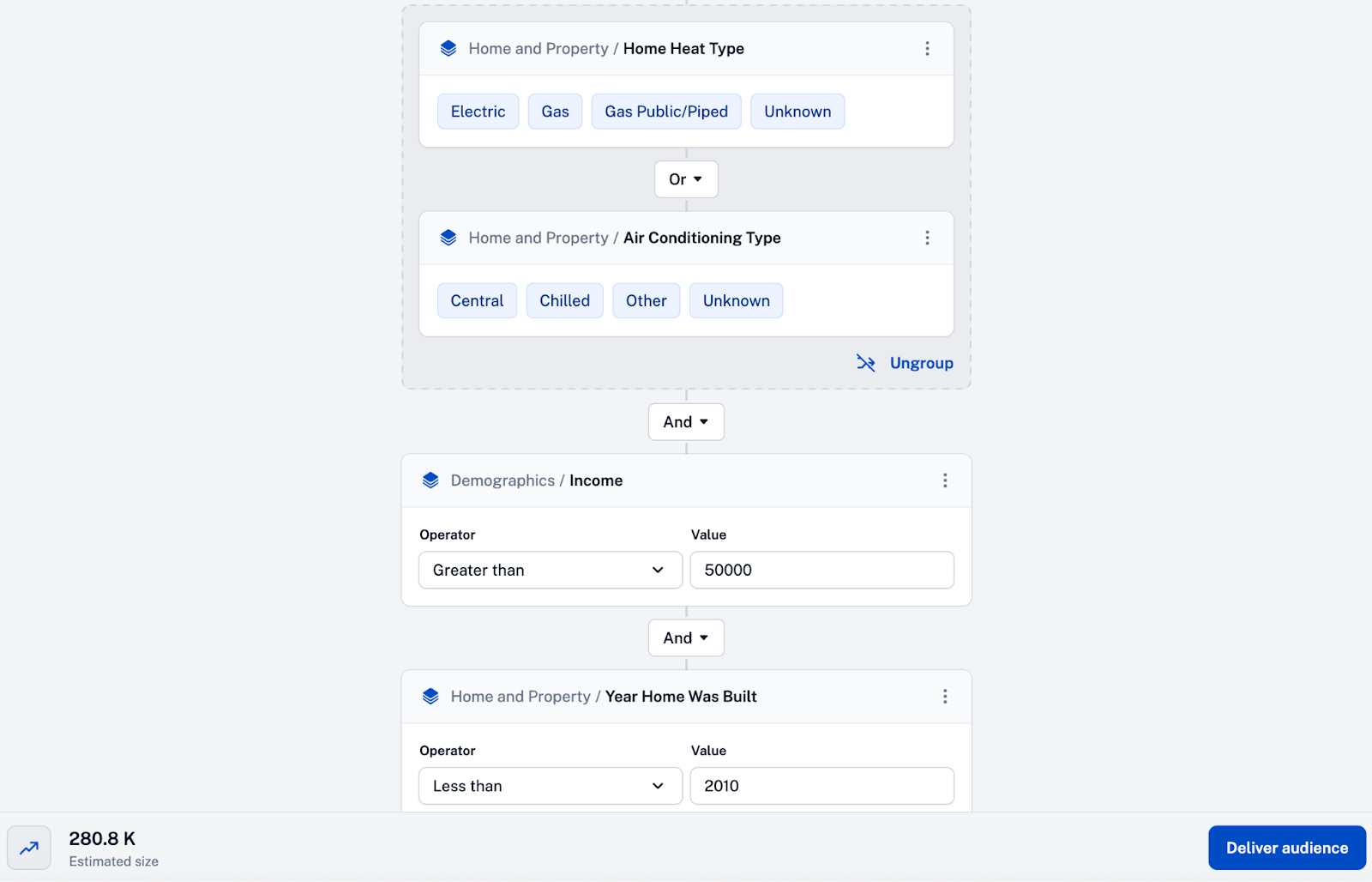
The screenshot above shows a real home age targeting build in Deep Sync’s Audience Builder: Home Heat Type (Gas or Electric), Air Conditioning Type (Central), Income greater than $50K, Year Home Was Built before 2010. Phoenix metro.
Estimated reach: 280,800 people.
That’s homeowners with an HVAC system at minimum 15 years old, at or past ENERGY STAR’s replacement threshold, with the equipment type you actually replace and the income to approve the job. In Phoenix, where AC failure in summer isn’t an inconvenience, it’s an emergency, that age filter is doing real work.
The ad writes itself: “If your Phoenix home was built before 2010, your AC is on borrowed time. Here’s what it costs to replace before it fails in April.” Not fear, arithmetic they can verify by checking their unit’s nameplate.
Compare that to a native “home improvement interest” audience in Phoenix: several million people, including apartment renters, students, property managers, and everyone who watched one episode of Fixer Upper. Same CPM. Different leads.
The property audience will likely cost more per lead, narrower reach plus the data fee. Whether that produces better downstream ROAS is what the test is for.
The Targeting Advantage Most Advertisers Aren’t Using
Property-level audience data is available, it connects to Meta, and most home services advertisers aren’t using it. That’s the opportunity.
The setup takes a half hour. The data fee runs 10–15% of the spend on any ad set using it. Start with one audience, your service area, central AC, year built before 2010, run it alongside your existing campaigns, and measure it against the same outcomes you track everywhere else.
That’s the whole test. It’s worth taking.