
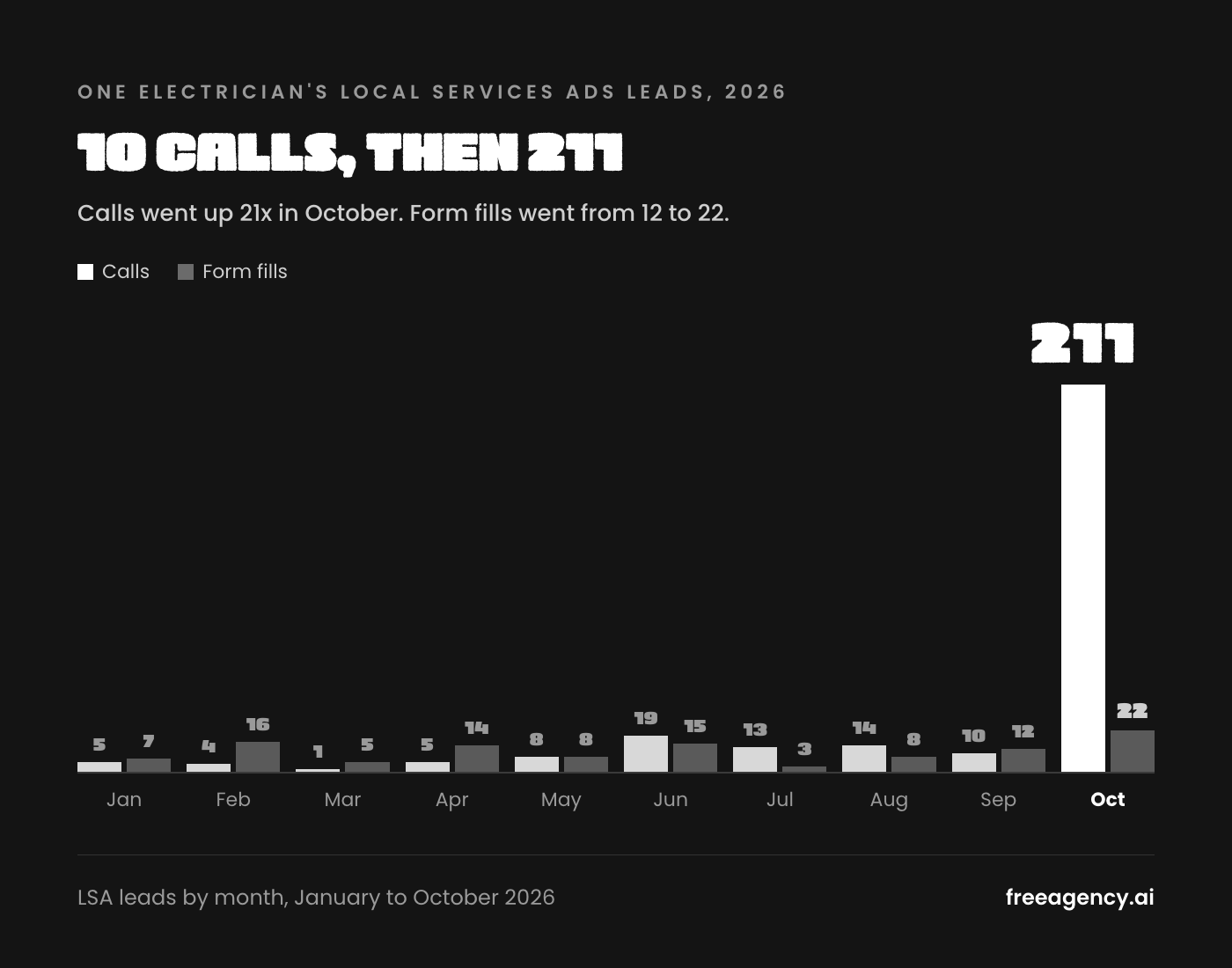
This electrician’s LSA call volume went from 10 calls to 211 in a month. Form fills went from 12 to 22.
 Styphanie DuplisseyChief Marketing Officer
8min read

Contents
- The numbers
- Why the calls versus form fills gap matters
- What we changed
- What this LSA call volume data can’t prove
- What Google actually says about hidden addresses
- How to check which profile is linked to your LSA
- The risks of changing it
- When showing an address isn’t possible
- If your account is underperforming, there is a reason
In September, an electrical franchise location in a major metro got 10 phone calls from Local Services Ads. In October it got 211.
Form fills from the same account went from 12 to 22.
Same account, same market, same month. Calls went up 21x. Forms didn’t come close. That gap is the most useful thing in this data, and I’ll explain why below.
I’m the CMO on the account. For most of the year its LSA call volume sat in the single digits, and total leads ran about 20 a month. A comparable sister market gets more than 200. The answers I kept getting were the usual ones. “They need more reviews.” “Everything is up and active, it should be fine.”
It wasn’t fine. The Google Business Profile linked to their LSA account had been turned into a service-area profile at some point, which hides the street address. We put the current address back.
Three problems with that story before you get excited. October is one month. My timeline has a hole in it. And one account is one account. All three are spelled out below, with the math.
The numbers
Here is every month of 2026 through October, plus October 2025. “Leads charged” is calls plus form fills. It adds up in every row.
| Month | Calls | Form fills | Leads charged |
|---|---|---|---|
| January | 5 | 7 | 12 |
| February | 4 | 16 | 20 |
| March | 1 | 5 | 6 |
| April | 5 | 14 | 19 |
| May | 8 | 8 | 16 |
| June | 19 | 15 | 34 |
| July | 13 | 3 | 16 |
| August | 14 | 8 | 22 |
| September | 10 | 12 | 22 |
| October | 211 | 22 | 233 |
| October 2025 | 0 | 17 | 17 |
Before and after, measured two ways so you can pick the comparison you trust.
| Lead type | Monthly average, Jan to Sep | Best prior month | October | Change vs average | Change vs best month |
|---|---|---|---|---|---|
| Calls | 8.8 | 19 (June) | 211 | +2,304% | +1,011% |
| Form fills | 9.8 | 16 (February) | 22 | +125% | +38% |
| Leads charged | 18.6 | 34 (June) | 233 | +1,156% | +585% |
And year over year.
| Lead type | October 2025 | October 2026 | Change |
|---|---|---|---|
| Calls | 0 | 211 | No percentage. You can’t divide by zero. |
| Form fills | 17 | 22 | +29% |
| Leads charged | 17 | 233 | +1,271% |
A few things in there are worth saying out loud.
October had more calls than the previous nine months combined: 211 against 79. Calls went from about two a week to almost seven a day.
Form fills did go up. Twenty-two is the biggest form month of the year, and I’m not going to call that flat. But it’s 12 more forms than an average month. Calls added 202. Calls account for 94% of the increase in leads.
The mix flipped. From January through September, calls were 47% of charged leads. In October they were 91%.
Why the calls versus form fills gap matters
Form fills are the closest thing I have to a control group.
If October had been a demand spike, or if somebody had tripled the budget, I’d expect both lead types to climb together. They didn’t. Forms were up 29% over last October. Leads overall were up 1,271%. Whatever changed, it changed the phone side.
I can’t tell you why an address on a Business Profile would lift calls and leave forms mostly alone. Google doesn’t publish that, and I’m not going to invent a mechanism. It also cuts the other way. A phone-only jump is what I’d expect from a phone-only setting, like business hours or how phone leads are configured. That’s on the list of things this data can’t rule out.
What we changed
One thing on the profile. The Business Profile matched to the LSA account was set up as a service-area business, so no street address showed. This location has a real office. My team submitted the current address, and Google required a video reverification before it would accept the edit.
I don’t know who converted the profile or when. Nobody got an alert when it happened. The LSA account kept running, kept showing as active, and kept producing just enough leads that nobody looked at the profile behind it.
What this LSA call volume data can’t prove
It’s one month. One full month after the change is better than a partial one. It is still one month. I’d want November and December before calling this the new normal.
The timeline is fuzzy. The address request went in around early August. Reverification took weeks. My best reconstruction is that it went live around mid-September, and I don’t have the exact approval date. Here is the part that bothers me: September had 10 calls, the lowest month since May. If the address was live by mid-September, the back half of that month showed nothing. Either there was a lag before it took effect, or it went live later than I think. Daily call data would settle it.
The baseline is strange. October 2025 had zero phone calls. March had one. An LSA account in a major metro shouldn’t go a month without a call, which tells me the phone side had a problem long before I found this one. I can’t prove the hidden address was that problem.
Correlation is not proof. This is one account. Business hours, phone lead settings, budget, bids, and review count can all move call volume, and I haven’t ruled each of them out.
What I will say is this. Calls never topped 19 in nine months, then hit 211. The address is the leading suspect. I’m not calling it proven.
What Google actually says about hidden addresses
Google does not say a service-area profile disqualifies you from LSA. Its Business Profile affiliation page requires every LSA advertiser to have a public, verified Business Profile, and the same page tells “pure service area” businesses how to verify theirs. So a hidden address is allowed.
I also haven’t found a Google page that says a profile with an address ranks higher in LSA. Plenty of SEO articles claim it. Google doesn’t. What I’ve seen in practice sits in between: a service-area profile will still run LSA, just not as strong as a listing with a verified address. Google doesn’t call it a deal-breaker, and I won’t either.
One more detail explains why this is easy to miss. For LSA accounts created from a Business Profile, Google pulls the business name, address, and location type from the profile, and those can only be edited there. Google also says only verified details get sourced. Pending edits don’t count. So nothing changes on the LSA side until verification is finished, which may be part of the lag in our timeline.
How to check which profile is linked to your LSA
This takes about ten minutes.
- Find the matched profile. In your LSA account, open the Business verification page. Google shows the Business Profile it matched to your ads there. Confirm it is the right one. With multiple locations or a franchise, a wrong match happens. If it’s wrong, Google’s instruction is to contact LSA support and not to create a new profile.
- Look at its location settings. Open that profile in Google Business Profile, select Edit profile, then Location. You’re looking for a street address or only a list of service areas.
- Check every location at once. If you manage several profiles, the Business Profile Manager list shows which ones have an address and which don’t. When I shared this internally, our team pulled that list across every client in a few minutes. Ten profiles had no address. Some were set up that way on purpose. Each one got a look.
- Ask whether the location qualifies. Google’s service area rules are specific. You can show an address if you serve customers there, your staff is available during your stated hours, and you have permanent on-site signage. No permanent sign means Google wants you listed as a service-area business.
- Split your leads by type. Pull calls and form fills separately for the last 12 months. A month with zero calls, or forms outnumbering calls most of the year, is the pattern this account had. I can’t promise it means the same thing on yours. It is a reason to look.
The risks of changing it
LSA is our most valuable asset for calls on most accounts (here’s the math on why). Treat the profile behind it like it’s worth that much.
Reverification. Google reviews profile edits before they go live, and a new address on a verified profile means verifying again. Ours required video and took weeks. Have someone on site who can film the signage and the inside of the building.
Suspension. If you show an address that doesn’t meet the rules, you are out of policy. Google’s affiliation page lists a suspended or disabled Business Profile as something you have to fix through appeals. You could trade 20 leads a month for zero.
Muddy data. Make one edit at a time. If calls move, you’ll know why.
When showing an address isn’t possible
Some businesses are true service-area businesses. You run trucks out of a home or a yard, there’s no sign, and nobody is there to greet a customer. Google’s rule for you is plain: if you don’t serve customers at your business address, remove it.
Don’t rent a virtual office to get around that. Google’s guidelines only allow one if it’s staffed during business hours.
We have a client in exactly this position, and we left the profile alone. The work goes into the things you can control: reviews, answering every call, accurate hours, and disputing junk leads for credit. You can still run LSA. I’d keep expectations honest about matching a market that has a verified storefront.
If your account is underperforming, there is a reason
Don’t settle for “it should be fine.” A dashboard that says active only tells you the ads are eligible to run. It doesn’t tell you what’s holding them back.
This account went a full month last year without a single phone call, and its status never changed. The problem sat in a location setting while everyone, me included, looked at reviews.
Now onto the next account.
Get it in your inbox, every Friday.
2,000+ trades owners already read it. Unsubscribe any time. @freeagency.ai on TikTok
Keep reading
More plays
How to set up a satellite office GBP (without building a graveyard of dead listings)
Your trucks drive through the same suburb every week.
Read the play
Home services earnings season: which marketing trends are real and which are still a bet
Roto-Rooter spent $4.3 million more on marketing last quarter than it did a year earlier, and what it bought was the same number of leads.
Read the play
Your 90% Booking Rate Is Fake
Say your ServiceTitan dashboard shows a 90% booking rate and your own read of the month is that the leads were junk.
Read the play