Home services earnings season: which marketing trends are real and which are still a bet
 Bri SkiffingtonChief Executive Officer
12min read

Contents
- The only public lead scoreboard, one quarter later
- Roto-Rooter’s answer to rising lead costs is a bigger ticket, not a bigger bid
- Google is turning the screws on anyone big enough to advertise
- Rollins says AI search is changing how customers find you
- Early ChatGPT ads data for contractors: still a bet, so don’t fund it from Google
- The channel that held up never went through Google
- Frontdoor lowered acquisition cost by selling to members it already had
- The rest of the earnings tape says the same thing
- Your play
Roto-Rooter spent $4.3 million more on marketing last quarter than it did a year earlier, and what it bought was the same number of leads. That’s the cleanest data point from a Q3 earnings season where the biggest public companies in home services told investors the same thing about home services lead costs: paid leads have a ceiling, and they’ve hit it. None of them answered by bidding harder on Google. Here’s what they’re doing instead, which of those bets the early data doesn’t support yet, and the one channel that kept growing through all of it.
The only public lead scoreboard, one quarter later
Nobody else in the trades publishes a lead report. Chemed, which owns Roto-Rooter, has to, because it trades on the NYSE and explains its numbers to analysts every quarter. In August I walked through the Q2 numbers and the mix math behind them. This is the Q3 update, from Chemed’s Oct. 28 earnings call.
| Roto-Rooter, year over year | Q2 2026 | Q3 2026 |
|---|---|---|
| Total leads | Down 1.6% | Essentially flat |
| Free leads from internet search | Down 13.1% | Down 11.8% |
| Paid leads | Up 7.3% | Up 5% |
| Paid share of all leads | About 59% (54% a year earlier) | About 60% (56% a year earlier) |
| Added marketing spend vs. prior year | About $3.1 million | $4.3 million |
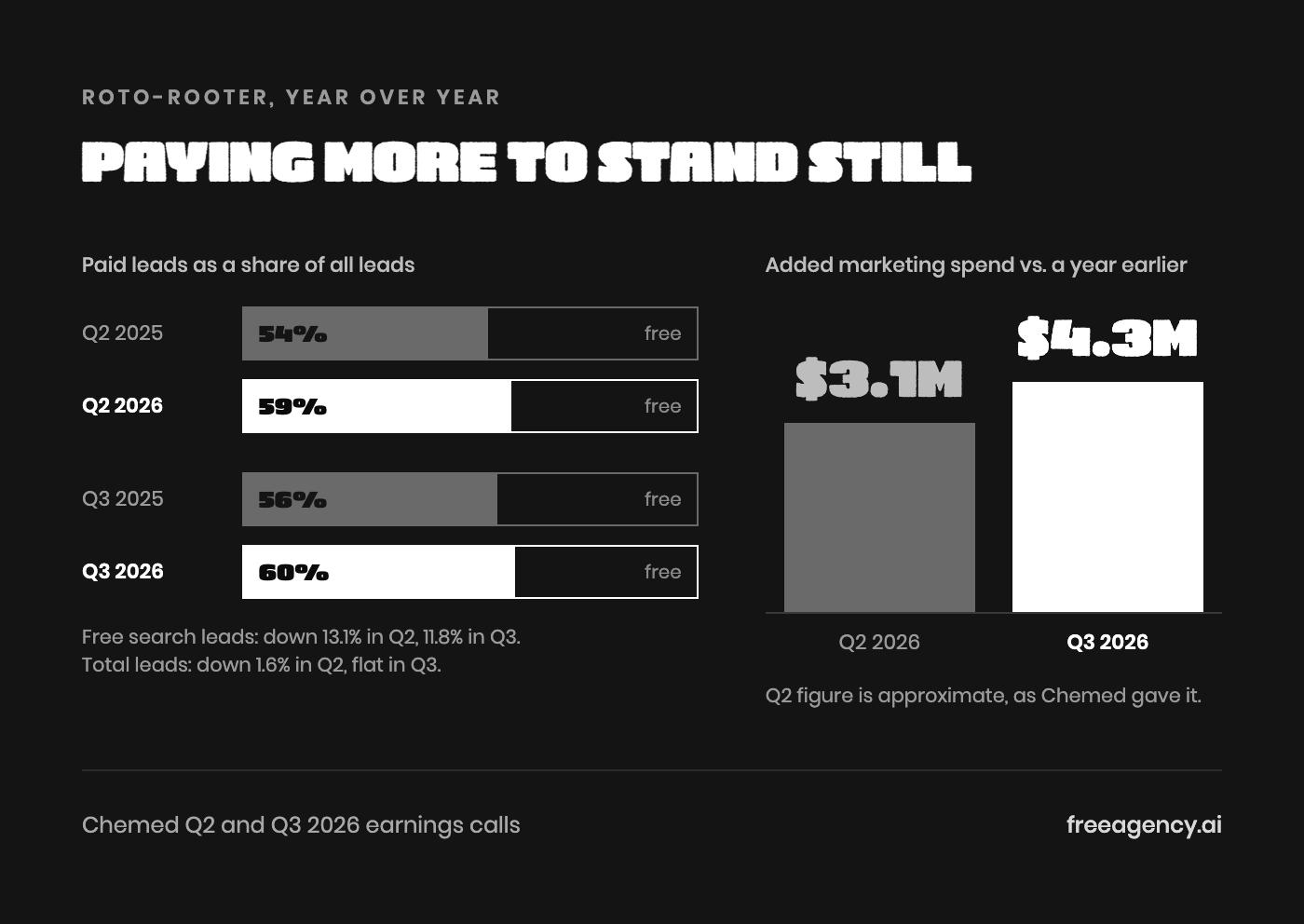
Read the two columns together. The free-lead decline eased a little. Total leads stopped shrinking. And the price of standing still went up $1.2 million in one quarter. Chemed didn’t publish a cost per lead, but CEO Kevin McNamara didn’t leave it vague: “We are paying Google more per lead. The bidding is going up.”
Here’s the math the call didn’t do. Moving paid share from 56% to 60% raises blended cost per lead roughly 5% to 7% on its own, before a single click gets more expensive, because free leads cost nothing at the margin. McNamara says the clicks are getting more expensive too. So the blended number is climbing from both directions at once.
Scale it to your size. That $4.3 million is about 1.8% of Roto-Rooter’s $233.5 million in Q3 revenue. Apply the same ratio to an $11 million shop and you get roughly $17,000 a month in added spend just to hold lead volume flat. In August, the same exercise came out to about $12,000. That’s a thought experiment, not a forecast for your market, but the direction is the point, and it’s why doubling your marketing budget won’t double your revenue.
The margin took the hit. Roto-Rooter revenue grew 7.5%, but adjusted EBITDA fell 2.5% to $48.2 million and the margin dropped 213 basis points to 20.6%, according to Chemed’s Q3 release. Don’t pin all of that on Google. Fuel cost an extra $1.4 million, and during the quarter Chemed paid about $62.5 million to re-acquire California franchise territories, a separate story that muddies the comparison. CFO Michael Witzeman said both the customer acquisition and fuel headwinds should carry into Q4.
Roto-Rooter’s answer to rising lead costs is a bigger ticket, not a bigger bid
The most useful thing McNamara said wasn’t a lead number. It was the plan. Roto-Rooter’s average job is now $1,500. It was $600 “not too many years ago.” Half its revenue comes from excavation and water restoration. His stated answer to rising lead costs: “In growing our average price per job, that will be how we handle the marketing issue.” He thinks Roto-Rooter can “outgrow a lot of the pernicious effects” of Google’s hold on the market.
That’s the right instinct, for a simple reason. Your cost to book a job doesn’t care what the job is worth. Pick a round number: if it takes $400 in marketing to book a job, that’s two-thirds of a $600 ticket and about a quarter of a $1,500 one. In ROAS terms, the same $400 returns 1.5x on the $600 job and 3.75x on the $1,500 job.
Same lead, same price, two and a half times the return, and none of it came from the ad account. It came from what happened inside the house. That’s why ROAS is a team score, not a marketing stat: marketing sets the cost of the lead, and operations sets what it’s worth.
It’s starting to show up. Average price per job in water restoration rose 2.8% year over year, which McNamara called a reversal of a multi-quarter downward trend.
For an HVAC or plumbing shop, the version of this is the replacement, the membership, the mitigation job, and the second visit you book before the truck leaves the driveway. The discounted tune-up you’re paying full freight to acquire is the other version.
Google is turning the screws on anyone big enough to advertise
McNamara also said out loud what a lot of owners suspect about their own markets. “I think we are seeing a little bit of panic by some of our competitors,” he said, describing rivals pushing up bids for paid placement. In his telling, Google is “discriminating against any company that advertises,” and once you’re big enough to buy ads, it’s going to “turn the screws on you.”
Even his own brand isn’t safe. He said there are “3 sections of paid advertising” above the free listing, and that someone searching “Roto Rooter Plumbing” would likely see “7 or 8 competitors” before Roto-Rooter’s phone number. Branded searchers, as Chemed’s management put it, don’t sort paid from unpaid. “They just click the first 1 available.”
Who loses in that auction? Witzeman said “smaller, less sophisticated plumbing companies are really struggling in this environment.” The California franchisees Chemed just bought back had been spending a noticeably higher share of revenue on internet marketing to get the business they got.
Here’s the uncomfortable part. Some of the bidders McNamara is watching are probably shops like yours, answering a rising cost per lead with a higher bid. That’s how the floor rises for everyone in the auction. Don’t be the bid that raises it.
Roto-Rooter is counting on a floor the auction can’t reach. McNamara said over 50% of its customers are repeat customers who come to the internet looking for the Roto-Rooter number, and he called that “a natural floor.” The Roto-Rooter app has passed 300,000 downloads and brings in 1,000 to 1,500 leads a week. Branches with commercial business managers grew commercial revenue 10.9%, against 4.8% for branches without one. Management believes leads from AI search are increasing but said they’re hard to track, and that Google is still “the elephant in the room.”
One label before moving on. McNamara said that if the next 12 months are “a flat or improving situation,” he doesn’t expect marketing to keep dragging down margins year over year. That’s a management forecast stated as a conditional, not a result.
Rollins says AI search is changing how customers find you
Pest control isn’t HVAC or plumbing, but the mechanism Rollins described applies to any local service sold through search. Rollins, which owns Orkin, grew Q3 revenue 6.2% to $1.09 billion, with 4.4% organic growth, per its Q3 release. Commercial grew 6.6% organically. Residential, the part that lives on digital lead flow, grew just 2.3% organically.
CEO Jerry Gahlhoff’s explanation on the Oct. 22 call: “AI and LLM-driven search are meaningfully changing the way customers discover service providers.” The LLMs recommend a wider range of providers, he said, and the answers vary by platform, by market, and even by day for the identical search.
The tape: organic website traffic was down 13% year over year in August and down 4% in September, and organic search leads improved 5% from July. Rollins warned that Q2 also showed signs of life that didn’t hold, and said lead volumes weakened further from Q2. It cut 2026 organic growth guidance to 4% to 6%, from 6%. Its long-term 7% to 8% organic target is a target, nothing more.
Selling and marketing spend rose to $146.3 million from $138.9 million, roughly flat as a share of revenue, and adjusted EBITDA margin fell 170 basis points to 23.5%. Rollins frames this as a discovery problem, not a demand collapse. Its recurring residential base is still growing, and price increases are still landing at 3% to 4%.
Two of its responses are worth copying this week. First, price. Rollins added pricing transparency to its sites and listings, and Gahlhoff said “doing something as simple as that has made a big impact.” His reason: when a company doesn’t give price ranges, the LLMs “assume the worst.” Second, plain-language service facts, like same-day and next-day availability.
The third response is the one to slow down on. Gahlhoff said Rollins has “begun taking advantage of new paid advertising opportunities on AI search platforms, including ChatGPT and Google Gemini.” CFO Will Harkins framed it as reallocation, not new money: “I would not assume that we are going to spend more in this environment.” Rollins is testing. A test at a company doing a billion dollars a quarter is not proof the channel works for a 12-truck shop.
Early ChatGPT ads data for contractors: still a bet, so don’t fund it from Google
The best contractor-specific data I’ve seen so far comes from our friends over at SearchLight Digital, who published ChatGPT ads benchmarks from 37 HVAC, plumbing, electrical, and mixed-trade contractors for June through September, with booking measured in each contractor’s CRM.
| Channel | Customers | Booked | Book rate | Revenue per lead |
|---|---|---|---|---|
| Paid ChatGPT | 279 | 95 | 34.1% | $654 |
| Google Ads | 73,893 | 36,063 | 48.8% | $893 |
| Google organic | 13,454 | 7,741 | 57.5% | $1,161 |
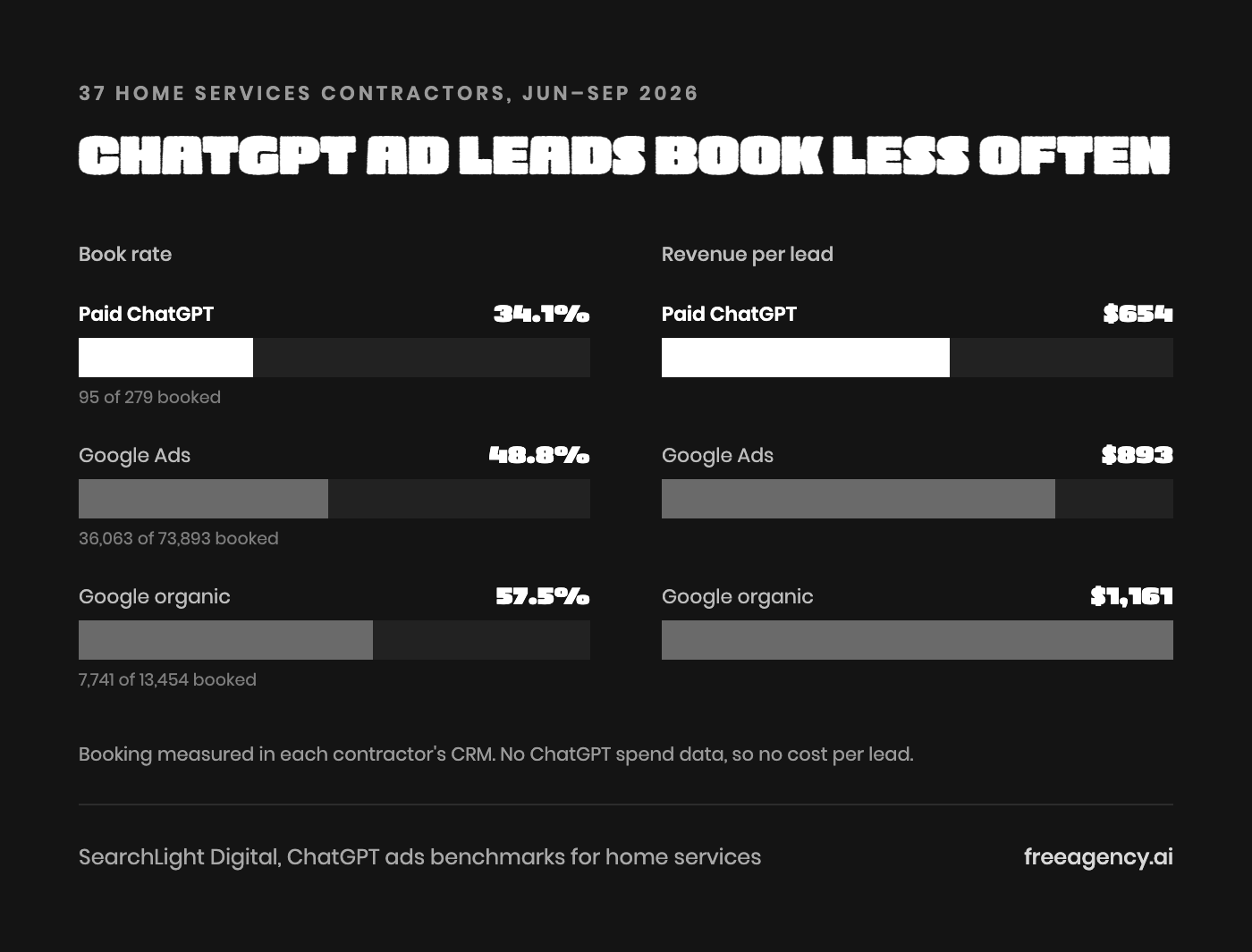
By SearchLight’s math, a ChatGPT ads lead was roughly 70% as likely to book as a Google Ads lead at the same contractor, and brought in 27% less revenue per lead. Volume barely registers. In September, contractors running both saw 93 paid ChatGPT leads against 16,371 from Google Ads, about 0.6%.
SearchLight’s own verdict: “ChatGPT Ads today looks like a growing, high-ticket, lower-booking channel: worth testing with tagging in place, not worth moving Google budget to.”
Read the limits the way they wrote them. SearchLight has no ChatGPT spend data, so there’s no cost per lead or return on ad spend in that table, only booking and revenue. Paid ChatGPT volume is a floor, because untagged leads land in organic or direct. And 37 paying customers is too small a base to lean on the average ticket. What the data does show is that these leads book less often and bring in less per lead.
Two broader studies point the same way. Neither one studies contractors, so treat them as context, not as a trades benchmark.
A working paper by Maximilian Kaiser and Christian Schulze looked at e-commerce advertisers after ChatGPT’s ad rollout. In US traffic, a paid ChatGPT visit generated $0.89 in revenue per session against $2.45 for a paid Google Search visit, and converted at 0.37% versus 1.17%. Of the 87 advertisers buying both channels, 97% earned less per ChatGPT visit. That’s last-click online shopping, not booked service calls, and the paper discloses that Kaiser advises its data provider.
Adthena reported that of 30 enterprise brands that shared July through September results, 52% were struggling to make spend pay back, 22% had mixed results, and 26% were matching or beating Google. Those are self-reported results from large brands, not a CRM study.
If you test, test it the way SearchLight describes. Tag every ChatGPT and Gemini ad so the leads land in the right bucket, give it its own small budget line, and judge it on booked jobs over 60 to 90 days. Don’t pay for the test by cutting Google. A month with a handful of leads tells you nothing.
The channel that held up never went through Google
Here’s the line from the Rollins call that got the least attention. Its door-to-door, direct-sales, and homebuilder-partnership brands, Fox and HomeTeam, grew well above the company average. Fox grew double digits. Asked whether those brands were showing any weakness, Gahlhoff said, “We’ve not seen any sign of weakness in those spaces. They have just gone gangbusters.”
That isn’t a pest control quirk. Those brands win customers through doors and relationships, not auctions, so they don’t feel the auction move. You have the cheapest version of that channel parked in a customer’s driveway every day.
In January I wrote that the cheapest job you will ever book is the house next door. Your truck is already on the street and your uniform is already visible, and techs still leave without knocking on a door, planting a yard sign, or handing over a referral card. One extra job on the same street lowers what that customer cost you. The faster lever from that piece is to turn every job into two: book the next visit before you leave, then pick up the neighbor.
None of that needs a better bid. It needs a tech who knocks on two doors and a CSR who books the next visit before closing out the job.
Frontdoor lowered acquisition cost by selling to members it already had
Frontdoor, which owns American Home Shield, sells home warranties, not service calls, so this is a contrast, not a comparison. Its sales and marketing costs rose to $87 million from $83 million, per its 10-Q. Management still said on the Nov. 5 call that “customer acquisition costs are trending lower, reflecting our shift toward performance marketing.” Frontdoor didn’t publish a unit acquisition cost, so treat that as direction, not a number.
The more useful line: non-warranty and other revenue grew 32%, to $78 million from $59 million, “led by our HVAC upgrade program,” with “little to no customer acquisition costs” because the buyer is already a member. Direct-to-consumer members grew 4% to about 330,000, while first-year direct-to-consumer revenue held flat at $54 million under promotional discounting.
Different industry, same move as Roto-Rooter: more revenue from a relationship that’s already been paid for.
The rest of the earnings tape says the same thing
ServiceTitan’s fiscal Q2 call in September put gross transaction volume at $26.8 billion, up 17%, about 200 basis points slower than recent quarters, mostly from lower job growth at existing customers. Customers’ lead volume grew “at a more moderate seasonal pace” in May and June, particularly for HVAC-focused customers, before stabilizing in July. ServiceTitan adjusted its second-half forecast to reflect the slower growth.
Angi’s Q3 release showed leads down 18% while revenue per lead rose about 10%, to $47. Don’t read that as a clean price index, because Angi is also shifting its pro mix away from heavily discounted legacy ad products, which lifts revenue per lead as volume falls. On the call, Angi said unbranded search traffic has fallen about two-thirds since 2023 because of changes to the Google search experience.
Yelp’s Q3 10-Q showed services ad revenue down 2% to $238.2 million on fewer ad clicks, partly offset by higher cost per click, with paying services locations down to 248,000 from 258,000.
Different businesses, same shape: fewer leads moving through the paid channels, and each one costing a little more.
Your play
You can’t change Google’s auction. You can change how much of your business depends on it.
- Run a paid versus earned lead mix every month, out of your CRM, not the agency deck. The inflation often hides in the mix, not the bid.
- When cost per lead rises, raise the ticket first. Memberships, the next visit, replacements, and mitigation work all spread the same acquisition cost over more revenue.
- Don’t panic-bid against national or PE-backed competitors. Search your own company name from a phone and see how many ads sit above you before your number does.
- Put price ranges and service facts on your website in plain language: what you charge, how fast you can come out, what you actually do. The models quote what they can find.
- If you test ChatGPT or Gemini ads, tag them, give them their own budget, and judge booked jobs over 60 to 90 days. Leave the Google budget alone.
- Make the neighbor and the next visit a process, not a hope. Every job ends with the next appointment booked and the two houses next door asked.
Every company in this piece has more money, more data, and a bigger brand than you do. None of them found a way to outbid the auction. The ones still growing went back to people who had already said yes once, or who lived next door to someone who had.
Get it in your inbox, every Friday.
2,000+ trades owners already read it. Unsubscribe any time. @freeagency.ai on TikTok
Keep reading
More plays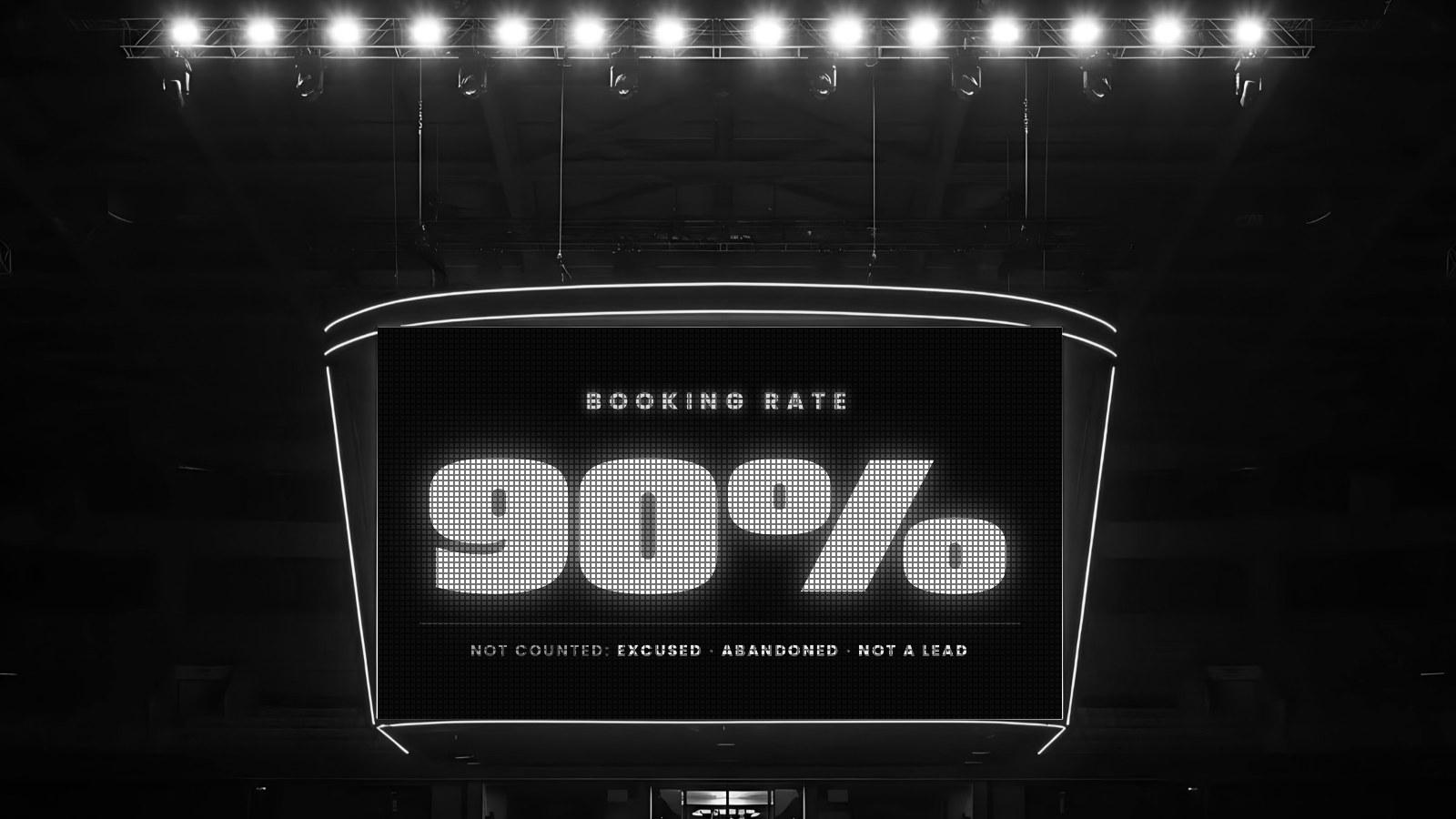
Your 90% Booking Rate Is Fake
Say your ServiceTitan dashboard shows a 90% booking rate and your own read of the month is that the leads were junk.
Read the play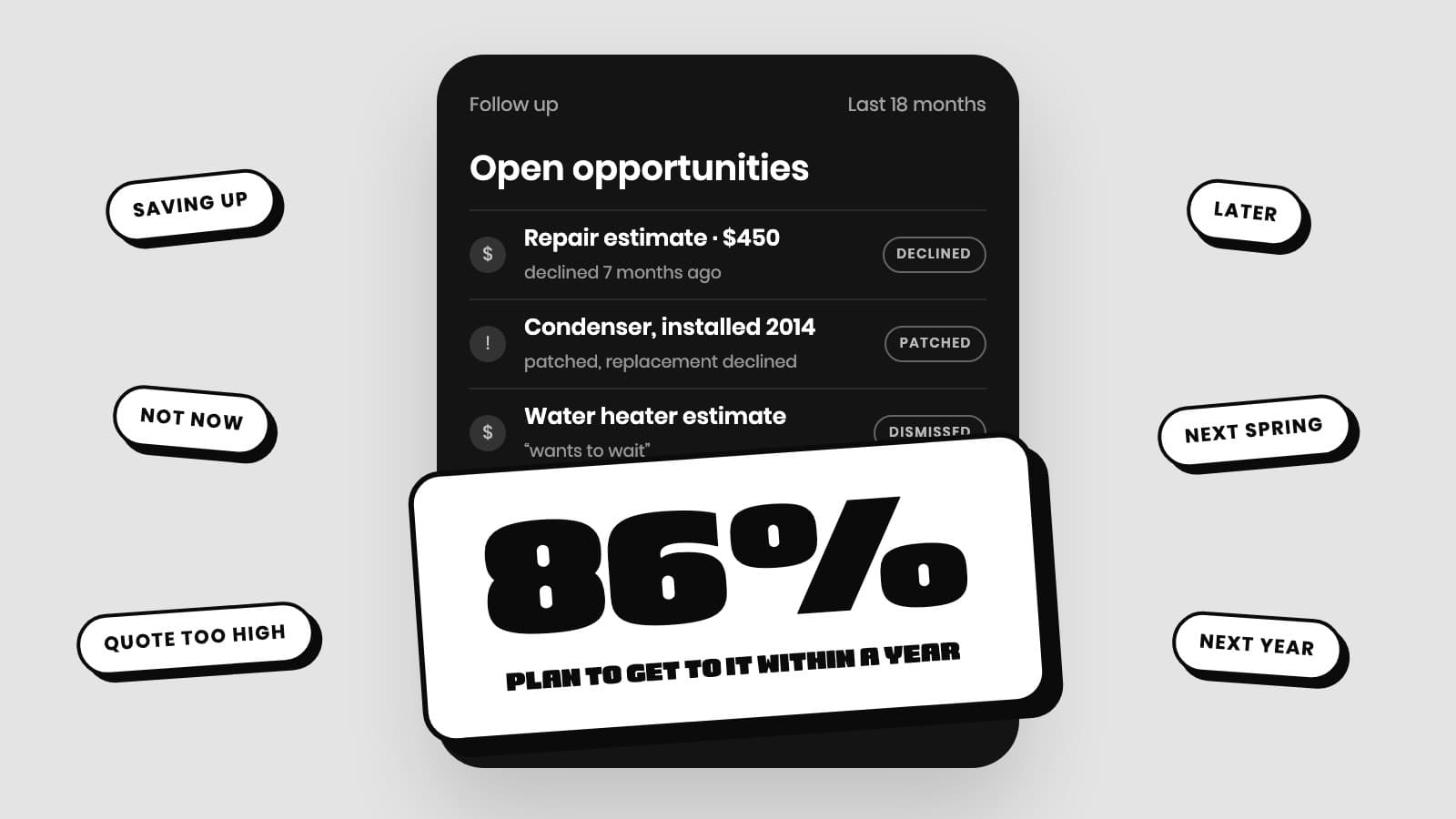
86% of homeowners putting off a repair plan to do it within a year. Build your 2027 budget around them.
A third of homeowners put off a needed repair in the last two years. Of the ones still waiting, 86% say they’ll get to some or all of it within a year (LendingTree).
Read the play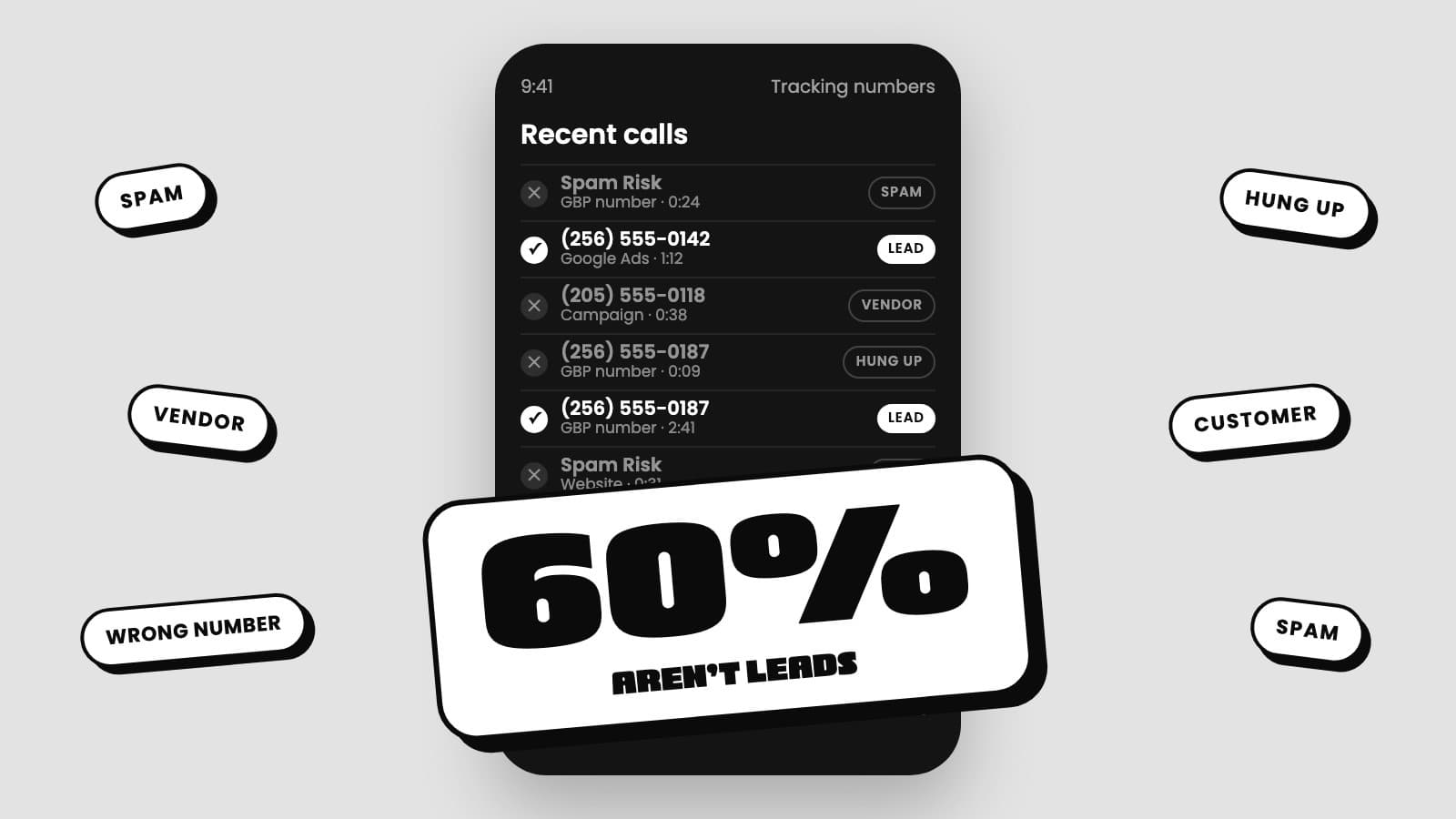
Study: 60% of paid search calls aren’t leads. Is your CPA hiding them?
Invoca analyzed home services calls for its 2026 benchmark and found that of the paid search calls a person actually answered, only 40% were leads.
Read the play