
86% of homeowners putting off a repair plan to do it within a year. Build your 2027 budget around them.
 Bri SkiffingtonChief Executive Officer
10min read
Contents
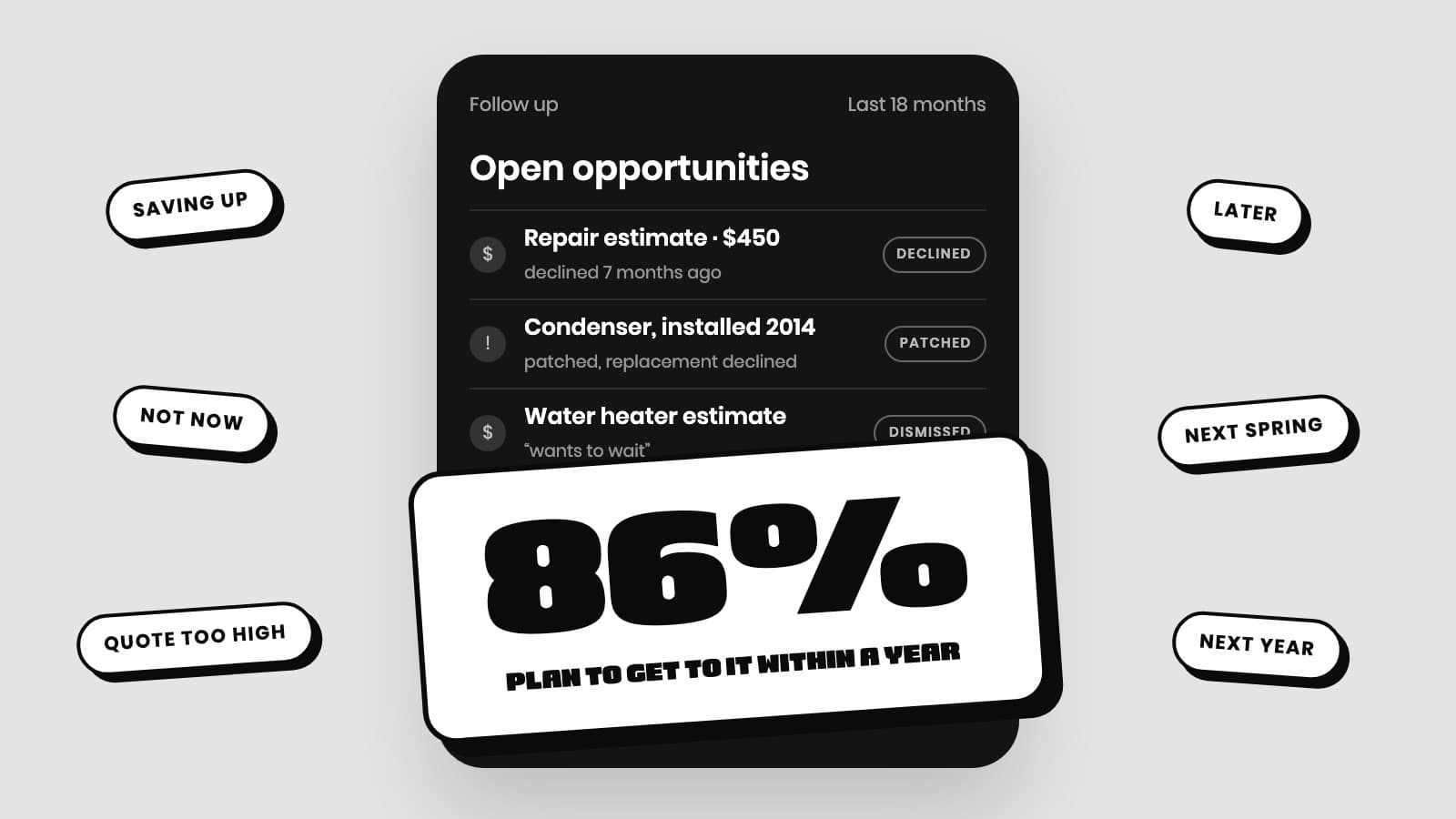
A third of homeowners put off a needed repair in the last two years. Of the ones still waiting, 86% say they’ll get to some or all of it within a year (LendingTree).
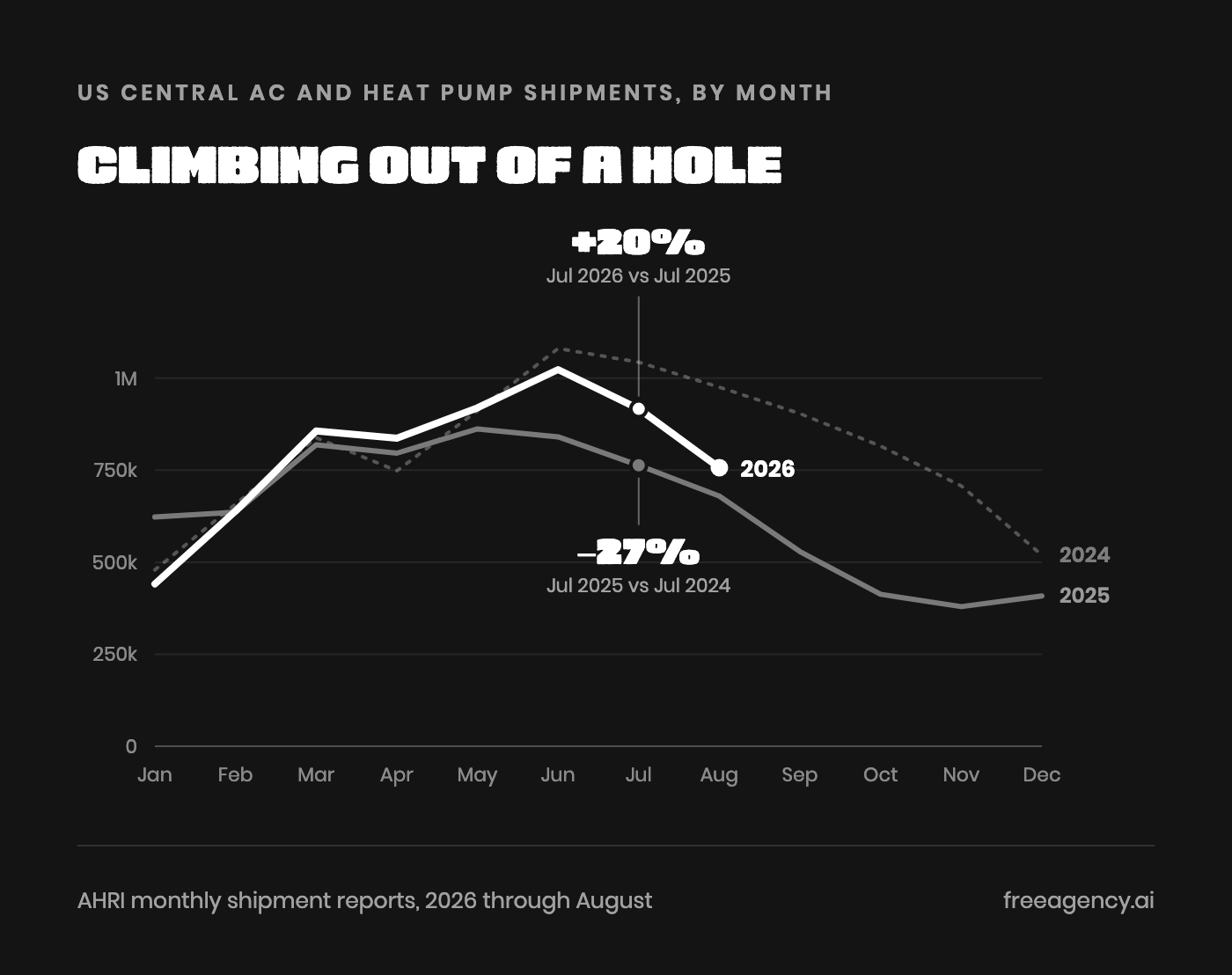
The equipment makers are betting on a comeback too. Last fall their reports were grim: central AC and heat pump shipments fell nearly 27% in July 2025 (ACHR News), and Carrier warned its third-quarter residential volume would drop more than 40%, its sharpest decline in more than a decade (ACHR News). This fall the headlines flipped. Shipments were up 20% in July (ACHR News) and 11% in August (ACHR News), and Carrier just told investors its residential sales in the Americas grew more than 30%.
Both stories are true. Neither one tells you what to do about the white space on your dispatch board this month. The part that does: in the HVAC slow season, the systems that didn’t get replaced last year, and the repairs that didn’t get done, are still out there. Most of them are already sitting in your ServiceTitan with a name, an address and a tech’s notes attached.
The recovery is real, and so is the hole it’s climbing out of
Read the manufacturer calls closely and the recovery has an asterisk. Carrier’s CFO said residential was up over 30% “benefiting from the absence of destocking.” Translation: this fall looks great next to last fall, when distributors stopped buying. Carrier now expects the residential market to land between 7.5 and 8 million units for 2026 (Carrier Q3 2026 call). Lennox reported residential sales volume down 3% and lowered its full-year outlook (ACHR News).
Big percentage jumps off a collapsed year don’t mean every homeowner who held off last year has come back.
Carrier’s CEO has his own explanation for last year’s drop. The industry averaged 9.7 million units a year from 2020 to 2024, about 3.5 million more than normal across those five years, and 2025 worked off about 45% of that (ACHR News). He’s right that some of the missing replacements were never parked; they were installed early.
But last fall Lennox’s CFO also said homeowners may be opting for repairs over replacements (ACHR News). A 2014 condenser that got a new capacitor and a contactor in 2025 didn’t get any younger. It got parked. And one rung down, on the repair side, the parked demand is even easier to see. (For the wider market picture, see the state of the HVAC industry in 2026.)
Homeowners are parking repairs too, and most of them plan to come back
The shipment reports measure the top of the problem: replacements. LendingTree’s survey, published October 26, measures the rungs below it. A third of homeowners (34%) put off at least one needed repair or maintenance task in the past two years (LendingTree).
The reasons are about money and timing, not need. Among homeowners with repairs outstanding, 34% are saving up for the work, 32% say they can’t afford it right now, and 23% say contractor quotes came in too high. Of people who needed repairs, 27% call their most serious one urgent or safety-related.
Here’s the number that matters for your winter: 38% of homeowners with outstanding repairs expect to finish all of them in the next 12 months, and another 48% expect to finish some or most. That’s 86% saying “later.” Almost nobody is saying “never.”
It hits every trade. On LendingTree’s list of delayed repairs, plumbing, water heater and sewer work comes in at 27%, heating and air conditioning at 23% and electrical at 15%.
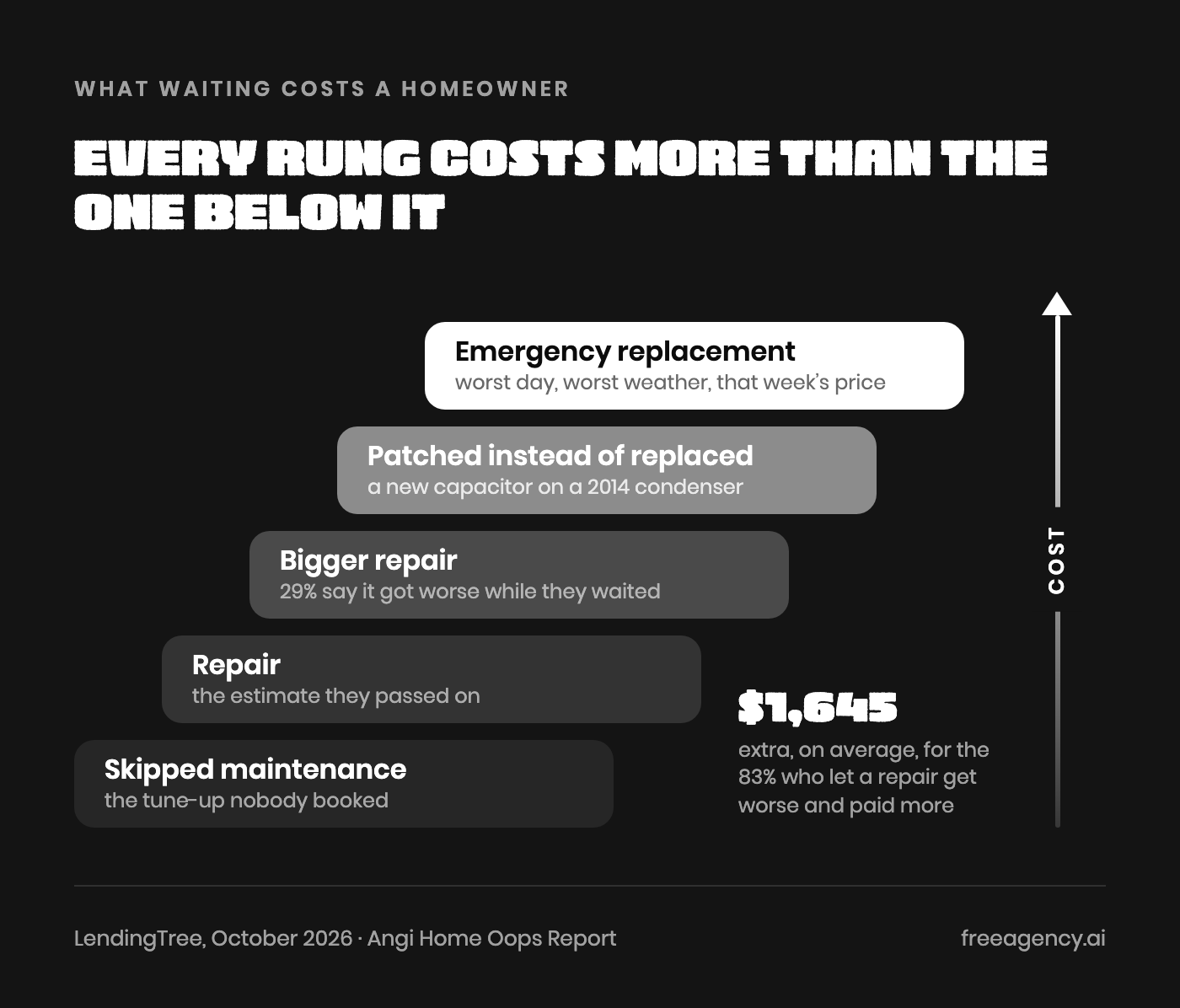
Put the two datasets together and you get a ladder. Skipped maintenance becomes a repair. A delayed repair becomes a bigger repair; 29% of the homeowners in LendingTree’s survey who need repairs said the original problem got worse while they waited, and 25% said it damaged something else in the house. The bigger repair gets patched instead of replaced. And the patched system eventually becomes a replacement on the worst possible day, in the worst possible weather, at whatever the price is that week.
Every rung costs more than the one below it. Angi found that among homeowners who knowingly let a repair get worse, 83% paid more than they would have by fixing it promptly, an average of $1,645 extra (Angi’s Home Oops Report).
No study connects AHRI shipments to a homeowner survey with a single number, and I’m not going to invent one. AHRI counts equipment leaving manufacturers, new construction included. LendingTree covers every kind of home repair. What they share is direction: the demand is postponed, and the bill grows while it waits.
Your parked demand has an address
National data tells you the queue exists. Your ServiceTitan tells you who’s in it. In most accounts we look at, three piles are sitting there untouched.
The first is declined repairs. When a tech builds an estimate on a service or maintenance call and the customer doesn’t buy, ServiceTitan turns it into an open opportunity automatically (ServiceTitan help). A $450 repair isn’t big enough for anyone to chase, so it ages out of sight.
The second is systems you patched after the homeowner passed on replacing them. These are your share of the replacements the market skipped. Your tech showed them a replacement option, they chose the repair, and you have the equipment age, the failure history and the declined proposal on file. This is a different pile from the proposals your comfort advisors are working this month, which our open estimate follow-up sequence covers. These are six to eighteen months old, and nobody has called since.
The third is dismissed opportunities. When a CSR dismisses an estimate because the customer “wants to wait,” that’s the definition of parked. ServiceTitan lets you reopen them.
Why do these piles go unworked while ad budgets go up? Because more prospecting spend is the easiest thing to sell an owner and the easiest thing to put on a report. The homeowners in these three piles already did everything your ads pay for, which is why neighbors cost less than new customers. They called, booked, let a tech in the house and saw a price. Prospecting traffic hasn’t done any of that yet, and some of it is parked too.
Work the parked list this HVAC slow season, before you raise ad spend
This is the playbook we run with clients when the board goes quiet. It takes a week, and the budget conversation waits until the end.
Pull all three piles. Run the Opportunity and Estimate Follow Up Report in ServiceTitan for the last 12 to 18 months, filtered to your service and maintenance business units (ServiceTitan help). Include dismissed opportunities. Where your techs log equipment on the location record, add system age.
If you already run an open estimate follow-up, don’t build from scratch. Clone it, change the subtotal filter from your equipment range to your repair range, and stretch the window from days to months. Same bones, different pile.
Sort by rung, not by ticket size. Safety items first: gas, electrical, carbon monoxide, active leaks. Then patched systems past their expected life, because those are the replacements that will happen in a heat wave whether you call or not. Then repairs that get more expensive if they wait.
Nice-to-haves go last. Sorting by dollar value puts the safety calls at the bottom, and those are the ones you’d regret.
Say the quiet part first, then lock the price. Your customers know the economy has a lot of people waiting this year; 34% of homeowners sitting on a repair told LendingTree they’re saving up for it. The first message should say that out loud, make waiting feel normal, and give them a reason the number you quoted won’t move:
“Hi {First Name}, it’s {Tech Name} with {Company}. A lot of homeowners are holding off on repairs this year, and that’s okay. We’ve locked in the price on your {repair} estimate through {date}, so there’s no rush on our end. When you’re ready, reply here and we’ll get you on the schedule.”
Only lock a price you’ll honor, and put a real date on it. On the patched-system pile, the lock carries extra weight: Carrier just told investors to expect about an 8% increase on residential equipment at the end of this year (Carrier Q3 2026 call).
The next touch, a few weeks later, carries the cost of waiting with your own numbers: what the repair costs now versus what the failure it prevents costs, or for a patched system, what the next repair runs versus the replacement. Use your job data; use Angi’s $1,645 only where you don’t have your own.
Skip the discount on the first touch. When a price comes in higher than expected, 68% of homeowners go get more quotes (Housecall Pro). A discount tells them your first number was padded. A cost-of-waiting comparison tells them your first number was the cheap one.
Lead with the monthly payment, then the total. Housecall Pro found 62% of homeowners are more likely to move forward when a payment plan is offered. LendingTree found only 3% are waiting because they couldn’t get financing.
Both are true. Financing doesn’t remove a barrier for most people; it answers “I’m saving up” and “not right now,” the two most common reasons people give for waiting.
Hold prospecting spend flat until the list is worked, then compare. Revenue closed from the parked list against what the same added ad spend produced last winter. That comparison is the most useful number you’ll have going into 2027 planning.
And keep that revenue out of your ad report. These are existing customers. Count them toward your ads and blended ROAS jumps while your new-customer numbers (CAC, NROAS) tell you nothing changed. That’s how good months hide bad marketing, and it’s why we build marketing budgets with new and existing customers split from the start.
What goes in your 2027 budget
Carrier is heading into 2027 expecting “recovering residential markets” (Carrier Q3 2026 call), and Lennox expects its recovery plan to drive growth as the year goes on (ACHR News). When that demand shows up, every contractor in your town with a marketing budget will be bidding for the same calls.
If you’re building next year’s plan this month, give the parked list its own line before you set ad spend. The cost is small next to a prospecting budget, and the return is about as high as marketing gets, because these homeowners already know your name, your techs and your prices. It needs three things to work.
Software that can text and email straight from your ServiceTitan data. Calling a few hundred homeowners by hand works once. It doesn’t work every quarter. Our take is in MarketingPro vs Chiirp vs Hatch: MarketingPro to build the audiences from ServiceTitan, Hatch or Chiirp to run the texts. Hatch is one of our preferred partners, and that post says so.
A comms plan that runs on the calendar instead of on whoever remembers. Make a pass before each peak season, when “this will cost more if it waits” is easiest to believe, and another in each shoulder season, when your techs have open slots to do the work. Safety items don’t wait for the calendar; those get a call the week they’re found. Our free SMS template pack, 13 automations mapped to ServiceTitan filters, is a starting point.
Someone who owns it. A list nobody owns turns into the same list next November. Put a name next to it and one monthly number they report: opportunities worked, jobs booked, revenue closed. If you don’t have a marketing leader who can own that, that’s the gap a fractional CMO fills.
Then size prospecting to the gap that’s left. Most 2027 budgets get built the other way around, starting from last year’s ad spend plus a growth percentage, and the cheapest revenue in the building never makes the spreadsheet.
The owners who win next year are the ones who used this HVAC slow season to call first, while “later” was still a decision and not a breakdown.
Your customer already decided to fix it. Your only job is to make “later” honestly more expensive than “now.”
Get it in your inbox, every Friday.
2,000+ trades owners already read it. Unsubscribe any time. @freeagency.ai on TikTok
Keep reading
More plays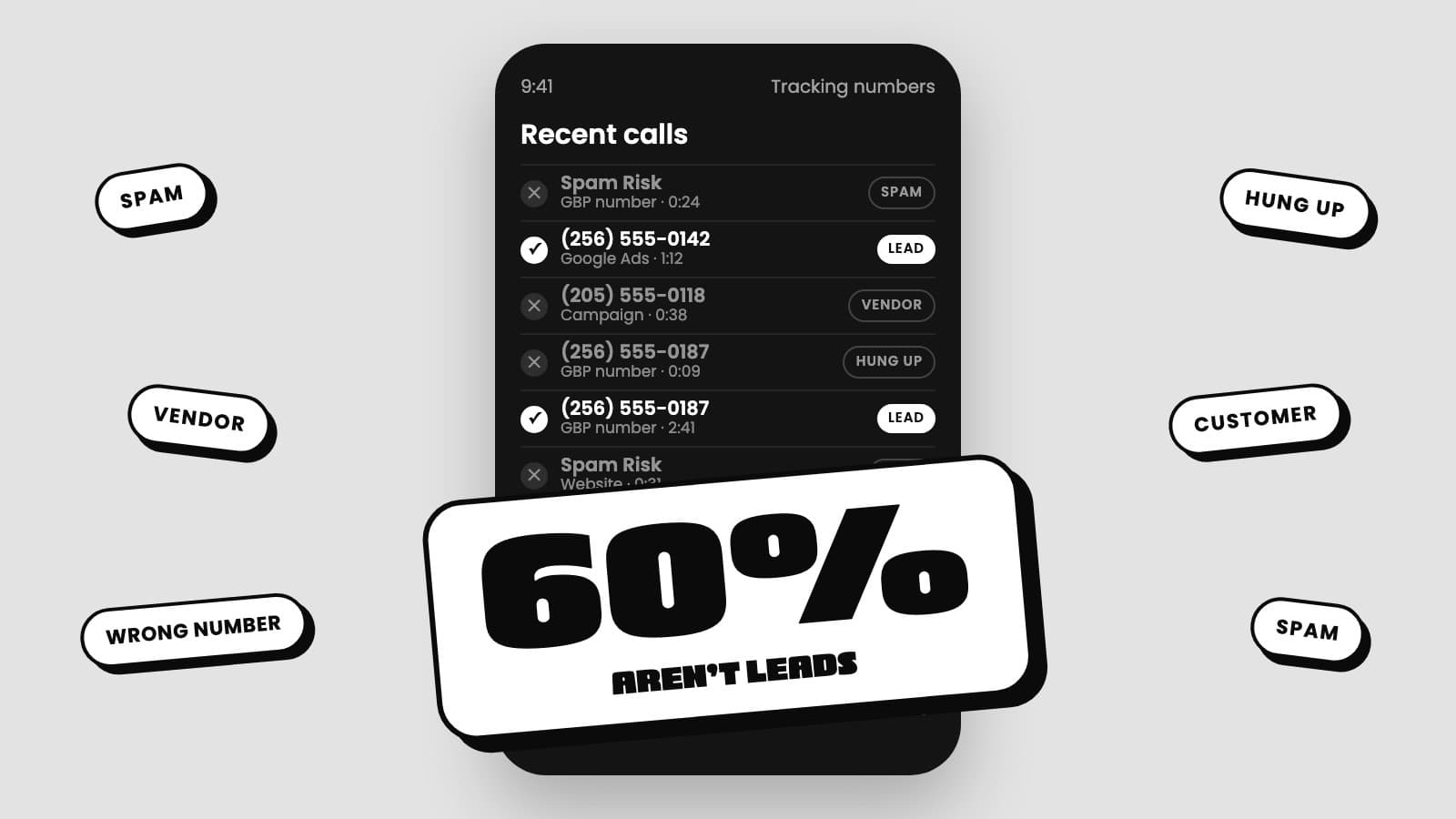
Study: 60% of paid search calls aren’t leads. Is your CPA hiding them?
Invoca analyzed home services calls for its 2026 benchmark and found that of the paid search calls a person actually answered, only 40% were leads.
Read the play
We turned our CMO playbook into software. Here’s exactly what’s in it, and what it costs.
Most of the people reading Free Advice Fridays will never hire one of our CMOs.
Read the play
Pantheon 2026, what’d I miss? Five numbers from Orlando that change your marketing math
The Homepros team counted the word “AI” at ServiceTitan Pantheon 2026. It came up 133 times, and that was just the conversations they were standing near.
Read the play