
Pantheon 2026, what’d I miss? Five numbers from Orlando that change your marketing math
 Bri SkiffingtonChief Executive Officer
8min read

Contents
The Homepros team counted the word “AI” at ServiceTitan Pantheon 2026. It came up 133 times, and that was just the conversations they were standing near. Three expo halls, two hotels, 110 breakout sessions. If you went, you missed most of it. If you didn’t go, you missed all of it and got the LinkedIn version, which is worse.
So here’s the version with a calculator. Five numbers came off the stage in Orlando that change how a $10M shop should think about its marketing spend. None of them require a ticket, and all five are sitting in your ServiceTitan right now.
60%: the room average for revenue realization
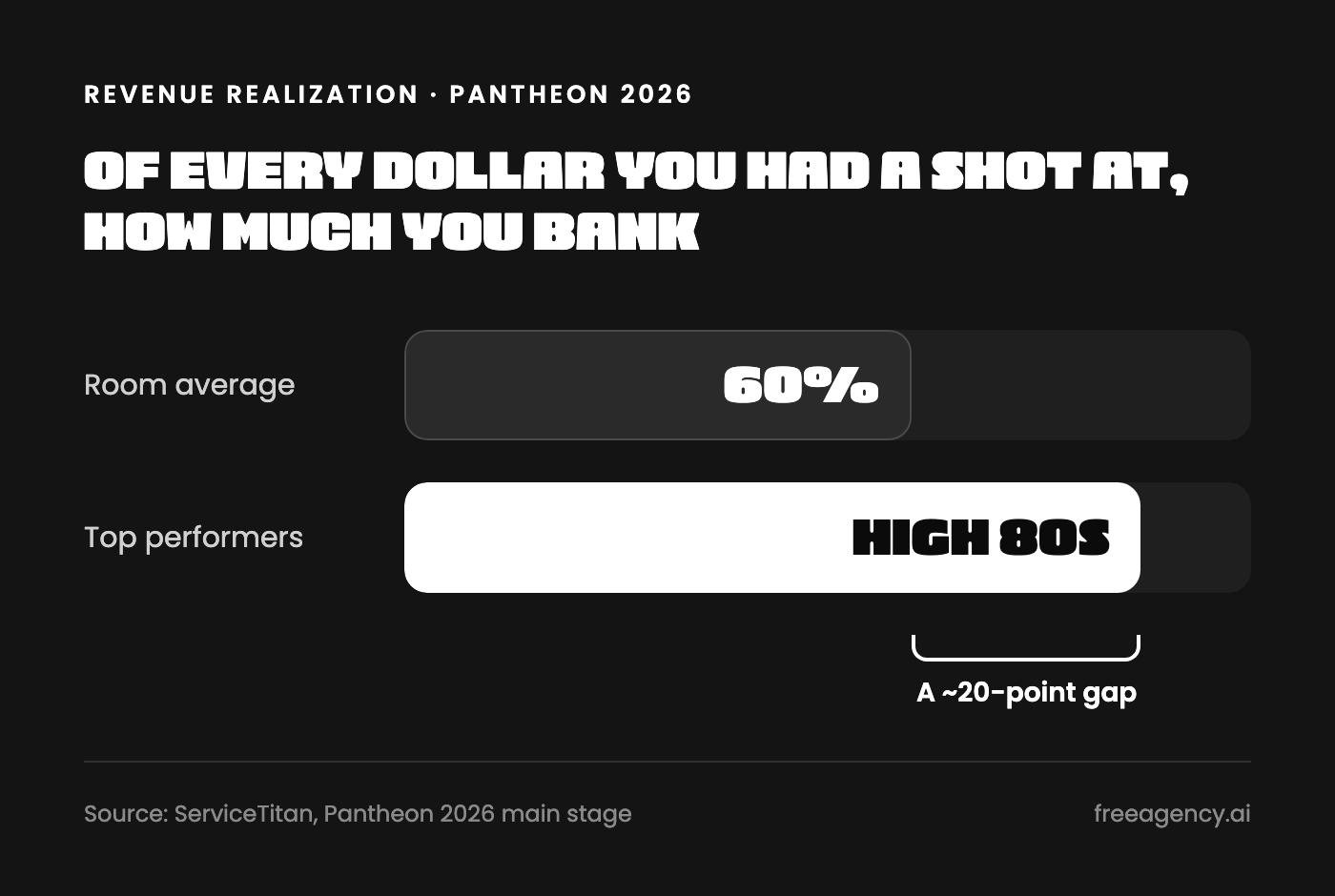
The biggest number at Pantheon wasn’t about AI. It was that the average contractor in that room banks about 60 cents of every revenue dollar they had a real shot at. ServiceTitan’s Vincent Payen put it on the main stage: the average revenue realization in the room is about 60%, while top performers reach the high 80s.
Revenue realization isn’t a report you can open in ServiceTitan. It’s an assessment: of the revenue that walked in the door as calls, visits and estimates, how much did you actually bank. Nobody on stage published the formula, so treat the 60% as an order of magnitude, not a benchmark to hit to the decimal.
Read that again if you’ve spent the last year telling your agency the board is light. Your instinct is “I need more leads.” You’re half right. If you’re running 22 jobs a day on a board that holds 35, the other half of that gap is calls that didn’t book, estimates that never closed, and jobs that cancelled before the truck left. A 20-point gap between you and the top of the room is bigger than any lead-volume lift an agency will put in a proposal, and it costs you nothing in media.
What to pull Monday: open estimates older than 14 days, with dollar value. Cancellation rate by job type. Unsold service calls where the tech recommended a replacement. Don’t bother with the booking rate report; ServiceTitan’s version is barely functional, and you’ll learn more listening to ten unbooked calls than reading it. Add the three up and you’ll have a number that makes your ad budget look small.
Three scores: punctuality, hired rate, satisfaction
Homh is the part of Pantheon nobody could explain in the hallway. Homepros listed it as a miss: no one being able to explain how contractors will be ranked. Vahe Kuzoyan explained it on stage, so here it is.
Homh is ServiceTitan’s consumer marketplace, now plugged into ChatGPT, Gemini and Claude so a homeowner’s AI assistant can find and book a contractor directly. It ranks contractors on three things: punctuality, hired rate, and job quality and satisfaction. Do your techs show up on time. After the visit, does the homeowner buy. What do they say afterward.
Two things make this a marketing story, not an ops story. First, ServiceTitan said those three metrics are becoming part of your reports and that they matter whether you’re on Homh or not. Second, the commitments Kuzoyan made are specific: you can’t pay to rank higher, they won’t charge you to remove a negative comment, and they won’t charge you to promote a positive review.
Now the part the stage didn’t cover. Homh is invite-only in a few key areas, for now. The public roster on homh.com/pros lists 11 metros and is heavy on Southern California. And the press release’s forward-looking statements name plans to extend Homh into consumer large language models and AI advertising platforms, and business or pricing strategy. No pay-to-rank is a real commitment. It is not the same as free. The per-booking question is open, and ServiceTitan says so in its own filing language.
Punctuality is the one I’d start with, because it’s the one you control completely and the one most shops don’t measure at all. The common arrival window in this industry is four hours. At Space Heroes, the HVAC company I co-launched in Huntsville as a live test bed for everything Free Agency recommends, we guarantee a two-hour window and measure every job against it. That’s not customer-service theater. If a homeowner’s AI assistant is scoring you on whether the tech showed up when you said, a four-hour window means you promised almost nothing and still get graded on it. A two-hour window you actually hit is a marketing asset you can put a number on.
What to do about it: pull your own three numbers this week. On-time arrival rate against the window you promised, from dispatch. Hired rate from your estimate conversion. Satisfaction from whatever review or survey flow you run. If an AI agent is going to read those before a homeowner ever sees your truck wrap, you should read them first.
One phone call: the customer already has a price
Chad Peterman of Peterman Brothers said on a Pantheon panel that more callers ask for a price on the first call, and he ties it directly to ChatGPT. Tom Howard said his plumbers were losing water heater jobs to a lower number the customer found online.
Neither of them fixed it by cutting price. Peterman’s fix is speed: when a tech finds a failed system, the homeowner gets connected to one of six virtual salespeople over Zoom, closing in the 60% range, instead of waiting two hours for a comfort advisor while they call their uncle. Howard put the water heater on the truck and offered to install it on the spot. Close rates went up.
The channel behind this is also moving. Homepros reported the same week that ChatGPT ads are going performance-based, with advertisers reportedly paying only when an action like an appointment booking happens. Whether or not you ever buy one, the homeowner on the other end of that ad has already been told what a water heater costs.
What to check: listen to five “how much does it cost” calls from last week and time how long it takes your CSR to get past the number. Then time the gap between a tech finding a replacement and a quote landing in the homeowner’s hand. That second gap is where the uncle calls.
Four trucks, no price tag
Max is open now. ServiceTitan said it: Max will be open after Pantheon to all customers in plumbing, heating, electrical and garage doors with four or more technicians. There is no published price for Max. Atlas, the AI assistant that got the mobile app and the “chief of staff” upgrade, has no pricing and packaging set yet either, and it goes to Max customers first.
The reason Max comes first isn’t marketing. It’s data. Command Center, the ranked-recommendations tool that was the most impressive demo I read about, is in private preview for Max customers only. A ServiceTitan product manager explained why on stage: if you’re not on Max, a lot of your data isn’t in ServiceTitan. Atlas needs call recordings and field data inside the platform to tell you why one tech averages a $5,000 ticket and another $10,000.
Full disclosure before the next paragraph: I built my own agentic chat and field recording software, CxC.ai, that integrates with and reads your ServiceTitan data for a fraction of the cost. I am biased toward it. Weigh what follows accordingly.
On the results claim: ServiceTitan’s CTO said some customers on Pro and Max products grew revenue twice as fast year over year as non-Max peers. The first 50 Max customers were hand-picked and coached for a year. Growth-hungry shops that volunteer for a pilot grow faster than shops that don’t, with or without the software. That doesn’t make the claim false. It makes it unproven for you. Correlation, not yet causation.
58%: the trust number ServiceTitan published itself
Same source as the last section, different kind of number. A vendor’s claim about its own product on hand-picked customers gets discounted. A vendor publishing a figure that hurts its own pitch gets weighted, because nobody puts that in a press release unless it’s true.
A week before Pantheon, ServiceTitan released its own survey of more than 1,000 contractors. The headline was adoption. The number worth keeping is trust: only 11% of contractors place high or complete trust in the AI tools they use, while 58% report little or no trust.
The same survey found contractors report stronger gains in productivity and decision-making than in revenue or profitability. Hours saved. Faster answers. Not margin.
The floor agreed. One operator told Homepros: “AI fatigue is real, and it’s tough out there for a lot of operators. I think willingness to spend on new flashy stuff is depressed.” Another said his job was basically training AI to take his job.
What to do with it: if an AI tool saves your dispatcher six hours a week, write down what those six hours became. Six more booked calls is a number. Six hours of less stress is a benefit, not a return. Both are fine. Only one belongs on the scoreboard next to the invoice.
The Monday list
Five pulls, in order:
- Revenue realization. Open estimates over 14 days, cancellations, unsold recommendations, ten unbooked calls.
- Your three Homh scores. On-time arrival against the window you promised, hired rate, satisfaction. Whether you’re invited or not.
- Five “how much” calls and the time from found-problem to quote.
- Your pre-Max baseline, by the numbers in item one, before anything agentic touches the data.
- Hours saved by every AI tool you already pay for, converted to dollars or struck from the ROI slide.
Pantheon 2027 is in Nashville next September. Between now and then you’ll be pitched Max, Homh, Atlas, and a dozen agents that do the same thing from companies that aren’t ServiceTitan. The breakout rooms were optional. The scoreboard isn’t.
Get it in your inbox, every Friday.
2,000+ trades owners already read it. Unsubscribe any time. @freeagency.ai on TikTok
Keep reading
More plays
We turned our CMO playbook into software. Here’s exactly what’s in it, and what it costs.
Most of the people reading Free Advice Fridays will never hire one of our CMOs.
Read the play
Roto-Rooter just spent $3.1 million more to get fewer leads
Nobody in this industry shows you their lead counts. Not the consolidator buying up your market.
Read the play
The state of the HVAC industry in 2026: price increases, private equity, and beating both
You already know the headline numbers, because you lived them this year. Equipment costs that make you wince before you update the pricebook.
Read the play