
We turned our CMO playbook into software. Here’s exactly what’s in it, and what it costs.
 Bri SkiffingtonChief Executive Officer
10min read
Contents
- The Free Agency Software metrics leave nowhere to hide: CPNP, CAC, and NROAS
- The Moneyball Marketing™ layers: a native toggle that cuts the bullshit out
- It turns your annual goal into a daily lead target, by layer
- AI True Booking Rate: the number CSRs have learned to game
- What’s free, what’s $999, and what the money actually buys
- What it won’t do yet, and who shouldn’t bother
Most of the people reading Free Advice Fridays will never hire one of our CMOs. I’ve known that for five years, since I started answering marketing questions in Facebook contractor groups for free, before Free Agency existed. The service starts at $15k a month and the ideal qualifier is about $1M a year in marketing spend, which rules out most shops. Giving the playbook away was never the question. That’s in our DNA. The question was whether we’d give the software that runs it to anyone, even competitors, to run on.
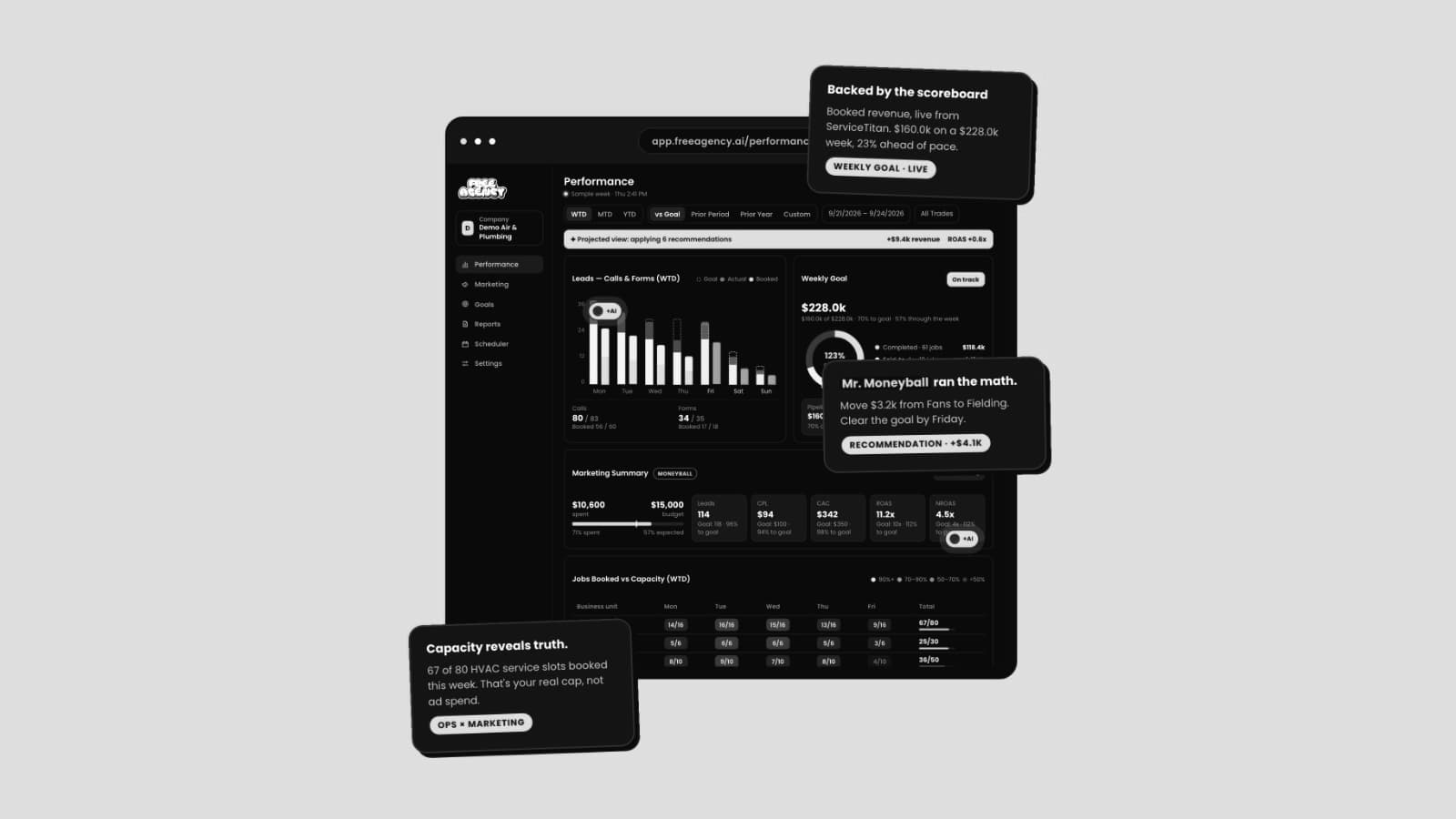
The answer is yes. On October 2 we released it. The Free Agency Software is the same scoreboard, the same metrics, and the same weekly recommendation our CMO team used to post 30% average client growth year to date. It’s $999 a month after a 30-day trial, there’s a one-time free game plan for anyone who wants to see their year scored first, and nobody has to sit through a sales call to get in. This is what’s in it, starting with the part no other platform has.
The Free Agency Software metrics leave nowhere to hide: CPNP, CAC, and NROAS
Every marketing dashboard on the market reports cost per lead. Some even report ROAS. Some make up their own, like Potential ROAS. All of them are easy to game, and they’re what your agency reports because they’re easy to game.
The Software replaces them with three metrics that don’t blend, don’t double count, and don’t give credit for customers you already had. I call it the virtual Bullsh*t Filter™.
Cost per new person (CPNP) replaces cost per lead. A lead is whatever the platform says it is. The same homeowner calls twice in a minute, fills out a form, and calls again Tuesday: four leads, one person. Across a year and across platforms it gets worse, because Google, LSA, and Yelp each count the caller as their own.
In the Software, however many times the phone rang become events considered for attribution, not proclamations of marketing success. Counting them as wins is an analytics failure, and you can’t blame ServiceTitan for it. The same flaw sits in Google Ads accounts everywhere. CPNP dedupes to the human. One person, one cost.
CAC is cost to acquire a new customer: total marketing spend divided by customers who had never bought from you before. Not spend divided by jobs, which counts your maintenance members. Not spend divided by booked calls, which counts the repeat caller from last winter. The denominator is people ServiceTitan has never seen.
NROAS is new-customer return on ad spend: revenue from first-time customers only, divided by what you spent to get them. Your blended ROAS includes the $9k replacement you sold to a customer of twelve years who clicked your brand ad on the way to calling you anyway. NROAS doesn’t.
Here’s why that matters even if your agency is bad at structure. Blended brand and non-brand, prospecting mixed with remarketing, prospecting mixed with database campaigns, paid mixed with organic: every one of those is a way to make a mediocre channel look like a good one. CPNP, CAC, and NROAS cut through all of them at once, because a returning customer can’t be counted as new no matter which campaign they came through. The agency doesn’t have to fix their account for the number to be more honest. The number is more honest at the source.
The Moneyball Marketing™ layers: a native toggle that cuts the bullshit out
Once the metrics are honest, the next question is where the money is actually playing. The Software has a native toggle that separates every dollar into the Moneyball Marketing™ layers: Fans, Fielding, Loading Bases, and Home Runs.
Mapping works off the campaign accuracy you already have in ServiceTitan. If Google is split into paid versus organic and brand versus non-brand, which is the minimum any agency should be giving you, the Software maps those campaigns to our standards. Fielding is the Moneyball term for the more universal prospecting: paid search, paid listings, paid social, the lead aggregators most agencies won’t touch. It’s the only layer where a budget change moves lead volume predictably.
Fans is brand visibility, TV and radio and billboards, where attributed return is near zero and real return shows up as branded search lift two layers over. Loading Bases is conversion capture: SEO, Google Business Profile, your website, brand search. Home Runs is your own database, email and SMS and outbound and referrals, where the acquisition was already paid for.
Score brand with non-brand, prospecting with database mail, or prospecting with website remarketing on Meta, and you learn nothing. You hijack credit to make the green arrows. A 7.6x blended ROAS that’s really a 100x brand campaign carrying a 3x non-brand campaign is the version of this we’ve published with the full table.
Score the layers apart and the recommendation writes itself. Mr. Moneyball, the recommendation layer, reads pace against goal and says: move $3.2k from Fans to Fielding, clear the goal by Friday. A dollar amount, a layer, and a deadline. Not “consider reallocating toward higher-performing channels.”
On Pro the algorithm runs continuously, applies multi-channel attribution rules, corrects attribution where the source field is wrong, and recalibrates on your own data over time. The free game plan scores your trailing twelve months once. It won’t tell you what to do Friday.
It turns your annual goal into a daily lead target, by layer
Connect ServiceTitan and your ad platforms once, and the Software takes the number you told your banker and works it backward to what has to happen today.
It takes your annual revenue goal, seasonalizes it against your own history and trade, and breaks it down by month, week, and day. Then it converts each of those into lead volume, by layer, at your real CPNP and booking rate. So instead of “we’re behind for the quarter,” you see how many new people this week needs from Fielding, what they should cost, where you stand by midweek, and the dollar move that closes the gap. That’s what a marketing lever looks like when it’s sized: which one, how much, and when.
Integrations, in plain terms: ServiceTitan, CallRail, Hatch, and Zapier on the shop side. Google Ads including PMax, Local Services Ads, Meta, and Yelp on the ad side. The site says 15 or more platforms; the full list is in the app. Connect once, stays synced. Real numbers inside the first week. First game plan adjustments inside 30 days.
AI True Booking Rate: the number CSRs have learned to game
Your booking rate is the number your CSRs have learned how to game, and you don’t have time to chase it by listening to calls.
A call comes in, the CSR can’t book it, and they mark it excused or not a lead. Duplicate caller, wrong service area, “just asking about pricing,” whatever the dropdown offers. Some of those are real. Plenty are a booking the CSR didn’t get. Every excused call leaves the denominator, the booking rate floats up, and you pay your agency against a lead count that was never the real one.
Pro scores every excused and not-a-lead call against an opportunity score. The CSR said it wasn’t a lead; the model scores whether it was. AI True Booking Rate is your rate once those scores are applied. The gap between the two numbers is your real call-center problem, sized in dollars. Missed lead reports surface the calls that scored high and went nowhere, which is the list your call center manager should be working Monday morning.
Humans still beat AI at the actual booking; what the model is better at is being honest about what got missed.
Then it writes the correction back into ServiceTitan. Auto-dispositioning means the fix lives in the system of record, not in a side report nobody reconciles. Per-job value prediction scores each lead on what it’s likely worth, so a $12k replacement call and an $89 filter question don’t count the same.
What’s free, what’s $999, and what the money actually buys
The free game plan is a one-time read of your trailing twelve months. Pro is the full system running daily, with the live algorithm, dispositioning, and 24/7 humans.
Free Game Plan, $0, once: connect ServiceTitan and your platforms, and the Software builds an annual marketing plan in minutes from a trailing twelve months of your performance, cost, and platform data. No card, no contract, no call. It’s for the owner who wants to see the shape of their year scored the Moneyball way before deciding anything. It doesn’t keep running after that; that’s what Pro is.
Pro, $999 a month after a 30-day trial with no card: daily sync, auto-dispositioning, event-level storage, missed lead reports, AI True Booking Rate, lead form booking rate, attribution rules and correction, the training loop, the live algorithm, per-job value prediction, lead platform credit requests, a campaign manager, offline channel tracking, operational goals by trade and layer, and 24/7 human support. The full Free Agency Software feature table is on the Software page.
Oh, and there’s a scheduler in it. That’s just a bonus.
Now the line that replaces the guarantee, because we don’t put a 10x guarantee on the Software. Across the CMO portfolio, the credit machinery recovers roughly 10 to 20% of paid listing spend as lead credits. Three things feed it: the opportunity score on missed leads, True Booking Rate reading the excused and not-a-lead calls, and bad lead reasons logged against each lead.
Google credits invalid LSA leads, and since it moved to automated lead credits the leads it misses are the ones nobody flagged in the feedback survey or disputed inside the 30-day window. Most shops leave that money on the table because the flagging is tedious and nobody owns it. We’ve written about why the credits are still there. The Software owns the filing.
The math on a $10k a month listings budget: $1,000 to $2,000 back. That covers the $999 before CPNP, the layers, or the recommendations do anything. At $30k on listings the Software is a rounding error on the credits alone. Run your own numbers against your budget before you decide it’s expensive.
What it won’t do yet, and who shouldn’t bother
The Software scores and recommends. It does not yet run your ads, replace your agency, or fix a call center that books half its calls.
It won’t manage campaigns for you. The campaign manager tracks and recommends; a human still changes the bids and writes the ad. That human can be your agency, your in-house person, or one of our CMOs. The Software makes all three accountable to the same number.
It won’t help if you’re not on ServiceTitan. Yet. The touchpoint to revenue match is the whole point, and today ServiceTitan is our primary integration. But Housecall Pro, Salesforce, and Dialpad are mapped and soon to follow. If you’re on one of those, set a reminder to come back in a few weeks for your free game plan.
It won’t help at DIY-stage ad spend. If you’re spending $5k a month, you don’t need a scoreboard yet. Read the blog, download the workbook, run the greenfield checklist, and come back when there’s a budget worth scoring. That’s not a brush-off. The free game plan is for exactly that stage: one honest look at the year, then go build.
It won’t make a bad Dugout good. High CPNP with a normal booking rate is a marketing problem. Normal CPNP with a low booking rate is an operations problem. Both broken at once is a foundation problem. The Software will tell you which one you have, in a week. It won’t hire the CSR, pick the agency, or decide for you when to bring marketing in-house.
One more thing it won’t do, and this one is a choice. Most service providers won’t share their internal software, because the software is the IP and the IP is what you’re paying the retainer for. Open it up and anyone can see how the sausage gets made. We’ve always said the opposite: the IP is what lets us be a service provider at all, and the service is where it gets applied with judgment. So the software goes public, the people stay the moat.
We exist because contractors got burned by agencies that kept the numbers behind a PDF. We weren’t going to keep them behind a login. Even from competitors.
Start the free game plan. Connect ServiceTitan and one ad platform. Look at your CPNP for last month next to the cost per lead your agency reported. Twenty minutes, no call, no card.
You don’t need to hire us to run our plays. That was the point.
Get it in your inbox, every Friday.
2,000+ trades owners already read it. Unsubscribe any time. @freeagency.ai on TikTok
Keep reading
More plays
Pantheon 2026, what’d I miss? Five numbers from Orlando that change your marketing math
The Homepros team counted the word “AI” at ServiceTitan Pantheon 2026. It came up 133 times, and that was just the conversations they were standing near.
Read the play
Roto-Rooter just spent $3.1 million more to get fewer leads
Nobody in this industry shows you their lead counts. Not the consolidator buying up your market.
Read the play
The state of the HVAC industry in 2026: price increases, private equity, and beating both
You already know the headline numbers, because you lived them this year. Equipment costs that make you wince before you update the pricebook.
Read the play