
LSA is moving to Google Ads: the hottest take (it’s lukewarm)
 Bri SkiffingtonChief Executive Officer
9min read
Contents
- What actually changes when LSA moves to Google Ads
- None of this is new. The move has been ten years coming
- The controls you’re losing were controls that didn’t even work
- The PMax badge is branding, and Google said as much
- The two changes that quietly help you
- What to do before your migration date
- The test to run on the next announcement
If you run Local Services Ads, your inbox had a busy week. Google announced on July 20 that LSA is moving to Google Ads, and within 48 hours the subject lines started arriving: urgent changes, major shakeup, LSA is now PMAX, what this means for your business. Then you opened them, and each one admitted somewhere around paragraph four (or straight up didn’t) that your ads will show in the same place, cost the same, and bill the same way.
We’ve managed LSA accounts since the Los Angeles pilot in 2016, back when the product was still called Home Services Ads, and we work daily in the API plumbing this migration formalizes. What follows is the hottest take the facts support: what changes, what doesn’t, and the two changes getting no airtime because good news doesn’t sell management services.
What actually changes when LSA moves to Google Ads
The dashboard moves, the budget math converts, a few controls retire, and everything that makes LSA produce leads stays where it was, so far. Google’s migration documentation is short and worth ten minutes of your time if you don’t believe us, because it’s the primary source everyone else this week is paraphrasing with more adrenaline.
The rollout is phased, starting in August with select US home and storefront service advertisers: plumbing, HVAC, electrical, appliance repair, roofing, pest control, the original cast. Broader groups follow late this year, non-US accounts in 2027. You get 14 days’ notice before your account moves, and a reminder at 7.
What stays: pay per valid lead, not per click. Search and Maps only, same positions. No keywords. Your Google Verified badge, your lead history, your call recordings, and your message threads all transfer.
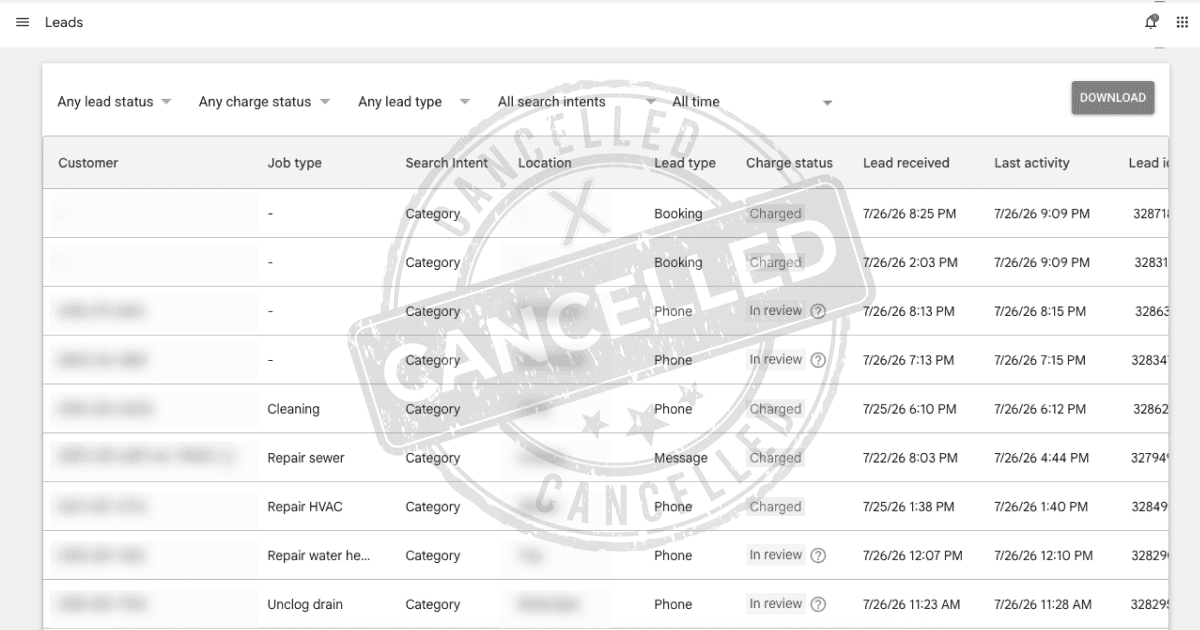
What changes: the standalone dashboard is retired, and on migration day your old login redirects into Google Ads. Weekly budgets convert to daily, your historical weekly average divided by 7, with monthly spend still capped at the daily figure times 30.4. Manual bidding and vertical-level target CPA retire in favor of a single campaign-level target. BBB callouts are gone; Google points you to the assets tab to pick at least six others. Leads move to a Lead Manager inside Google Ads with the same functions you have now: charged status, dispute form, CSV export. Historical performance reports do not come with you.
One more thing that stays, and it’s the one that pays your bills: nothing in the documentation touches how these ads rank. Reviews, responsiveness, profile quality, proximity. The same levers, earned the same slow way GBP signals are earned, none of them toggled in a dashboard. If you won the auction last Tuesday, you’ll win it after migration for the same reasons.
None of this is new. The move has been ten years coming
Google decided this years ago. The announcement is the interface catching up to the plumbing.
The product launched as Home Services Ads in a 2015 Bay Area beta for plumbers and locksmiths, background checks built in from day one. The pilot spread to Sacramento, San Diego, and Los Angeles through 2016, which is where we joined it. The Local Services rebrand came in 2017. Then the quiet wiring years. Billing was never really separate: Google’s own help docs state that LSA uses Google Ads to power billing and payments, and LSA manager accounts are Google Ads manager accounts you can only edit inside Google Ads. Lead data landed in the Google Ads API in 2023. The lead feedback and dispute workflow followed in 2025. In 2026 the dashboard, the last LSA-only artifact standing, moves in too.
For the technically inclined: the lead workflow you touch daily carries forward unchanged, while the campaign object itself becomes a Performance Max type. Campaign creation isn’t live yet in the API or in the Google Ads interface; new campaigns still start at the old LSA signup flow. Anyone promising total continuity or total upheaval is guessing past the documentation.
When a company migrates the billing first and the interface last, the decision was made years ago. This announcement is the press release for a project that already shipped.
The controls you’re losing were controls that didn’t even work
Every loss being mourned this week is something functioning operators never relied on.
Start with bidding. LSA never worked like the CPC auctions you know from search, where a $1,000 bid can genuinely cost you $1,000 for a click. In LSA, nearly everyone maxed their bids and cost per lead stayed roughly where the market put it. That’s why the standing configuration in the accounts we manage is autobid with a budget ceiling set high enough that it never binds. A $99,000 weekly budget on autopilot is not a strategy. It’s a shrug, and it’s the correct shrug.
We wrote two years ago that budget and bid barely move LSA performance because nearly everyone maxes them, and that review count, responsiveness, and rating do the real work. Google retiring the bid knob in 2026 mostly confirms how decorative it was. LSA returns 10 to 20x for many accounts. When a channel performs like that, the budget conversation is one word long.
The fair question is what protects your lead cost now that even the decorative ceiling is gone. The documented answer: a campaign-level target CPA, which Google optimizes toward as an average rather than enforcing as a per-lead cap, a monthly spend limit of your daily budget times 30.4, and, per Google’s Ads liaison, you still bid on job types within your service areas. Nothing in the documentation says per-lead prices change, and nothing guarantees they won’t. Cost per lead in the first weeks after migration is the number to watch, and it’s on our tripwire list below.
The weekly-to-daily conversion is arithmetic on a number that wasn’t constraining anything. If your budget was effectively “yes,” dividing it by 7 doesn’t change the answer.
The historical reports deserve a harder look, because losing data sounds serious. It isn’t. Every LSA call already rings through Google’s tracked number on its way to your CSRs, and if you route leads into ServiceTitan like nearly every operator at scale does, your CRM holds better history than Google’s dashboard ever produced: booked jobs and revenue per lead, not Google’s count of charged leads. You’re losing a report you stopped opening in 2024. If you want Google’s version anyway, export it before your migration date and file it somewhere you’ll never look.
The dispute workflow follows the same pattern. Nobody was disputing calls in the dashboard. The lead feedback and dispute functions have been available through the Google Ads API since 2025, and they carry into the Lead Manager intact. Same function, new address.
The PMax badge is branding, and Google said as much
The Performance Max name on these campaigns is structural, not behavioral. Google’s Ads liaison confirmed the reasoning publicly: Performance Max is the only campaign type that serves both Search and Maps, so that’s the box LSA had to land in. In the same breath, Google confirmed these campaigns will not expand into Display, YouTube, or Gmail. For now. Same placements, same positions, same reach LSA always had. Plus, advertisers are catching on that PMax is brand and remarketing first unless controlled otherwise, allowing agencies to gloat ridiculous performance unless they applied our Pmax framework described in this article. So to mitigate the distaste of PMax, it’s very convenient for the most effective product in home services marketing to take on that name.
Our read, clearly labeled as our read: folding the best-performing pay-per-lead product in local advertising under the PMax banner also flatters PMax by association. LSA was the original give-Google-a-goal-and-get-out-of-the-way product. Now its results count on PMax’s scoreboard.
The honest caveat is that unified infrastructure cuts both ways. The same rails that make this migration a non-event make future changes cheaper for Google to ship. The tripwires worth watching: placements creeping beyond Search and Maps, per-lead pricing behaving differently after migration, or the pay-per-lead goal itself getting deprecated. None of that is in this announcement. If any of it shows up in a future one, the calculus changes, and we’ll say so.
The two changes that quietly help you
Verification gets simpler, and your Business Profile becomes the one place you manage your presence. Neither improvement is getting coverage, because neither one is scary.
The background check regime is as old as the product. It shipped with the 2015 beta, and if you’ve onboarded an LSA account you know the drill: the multi-week background check cycle, the certificate of insurance re-uploads, the license documentation.
Google’s migration documentation retires a chunk of that directly. Insurance and license reverification are no longer required, and the Verified badge now rests on business registration and representative checks. Early reporting on the migration adds that the mechanism is an identity check matched against business registration through Dun and Bradstreet, the same style of advertiser verification Google Ads has phased in since 2020. The slowest part of LSA onboarding is collapsing into paperwork your business already has.
Your existing verified status doesn’t reset either. Google’s documentation says your verification and your Verified badge transfer automatically. When Google consolidated its badges into a single Verified checkmark last fall, we told readers to keep licenses, insurance, and background checks current because Google will pause ads over an expired COI. The migration retires that ritual. The one edge case worth checking: an LSA-only account whose Google Ads customer ID never ran a regular campaign and never completed advertiser verification. Confirm your verification status before your migration date, not after.
There’s also a quieter operational win. After migration, your business name, address, and hours sync from your Google Business Profile, and your photos transfer. One profile to maintain instead of two drifting out of sync, one less place a wrong holiday schedule hides. The caveat that matters if you’re mid-rebrand or mid-move: significant name or address changes can trigger a 24-to-48-hour verification review that temporarily pauses the campaign. Time your GBP edits accordingly.
And on support: in our experience, Google Ads support, whatever its reputation, resolves account problems faster than LSA support ever did. Faint praise. Still an upgrade.
What to do before your migration date
One thing, and it takes five minutes: confirm your Google Ads account is advertiser verified. In Google Ads, it’s under Admin, then Policy, then Account. If LSA is the only thing your customer ID has ever run, this is the one place the migration can actually snag you, because Google Ads pauses accounts that skip required verification.
While you’re at it, make sure your business has a DUNS number and that the name and address on it match your business registration and your Google Business Profile. Dun and Bradstreet runs a free lookup, and if your business moved or rebranded since the number was issued, the update through their D-U-N-S Manager is free too. If verification is going to match identity against business registration, you want those records agreeing with each other before Google checks, not after.
After migration day, glance at what transferred: service types, service areas, ad schedule, the budget math, and the account-level settings LSA never made you think about, auto-applied recommendations among them. Then leave it alone. Google’s own documentation says performance can take up to two weeks to ramp back, and panic-adjusting a fresh migration is how good accounts get worse.
The test to run on the next announcement
It’s worth being honest about why this announcement got the week it got. LSA is the most efficient lead source most contractors run, and any hint of change to it lands hard. In our own email sends, a subject line implying LSA might change roughly doubles the open rate. Everyone covering this news knows that, at least by instinct. Fear for your best channel is rational, and urgency is what gets opened. That isn’t a scandal. It’s the physics of attention, and it’s why the takes ran hot while the facts stayed room temperature.
So when the next urgent subject line lands, run one test before forwarding it to your marketing person at 6am: does this change how the ad gets bought, shown, or billed? If the answer is no, the drama is optional.
This one changes where the dashboard lives and how the account gets verified. Both got slightly better.
Get it in your inbox, every Friday.
2,000+ trades owners already read it. Unsubscribe any time. @freeagency.ai on TikTok
Keep reading
More plays
How to Target Homeowners by Home Age on Meta Ads
If you’re running Meta ads for an HVAC or plumbing company and haven’t tried home age targeting, there’s a reasonable chance you’re paying to reach people who rent.
Read the play
Lead Aggregators Case Study: Grasshopper Group
Last week, I wrote about lead aggregators as ROAS arbitrage.
Read the play
Stop Overpaying Google: How To Use Lead Aggregators For ROAS Arbitrage
Most contractors only think in channels. Google. LSA. Meta. Maybe Yelp if their rep won’t stop calling.
Read the play