
PMax Reporting: How Google Finally Opened The Black Box
 Bri SkiffingtonChief Executive Officer
6min read
Contents
PMax Reporting Just Got Its Long-Overdue Upgrade
Advertisers everywhere, rejoice: Performance Max reporting finally shows its cards.
In a calculated pivot toward transparency, Google has started exposing key data long withheld from advertisers—real search terms, channel-level performance, and asset-level insights. And as they simultaneously push the AI Max beta, the timing is no coincidence.
This isn’t transparency for transparency’s sake. It’s a strategic concession to regain advertiser trust, slow churn, and pave the road for broader AI adoption.
Control is still limited. But for the first time, you can start making sharper decisions inside PMax—and we’ll show you exactly how.
The Concession – What Google Just Released
This is not the dawn of AI replacing humans in PPC. It’s the pivot point where the nature of work shifts—away from manual bid and match-type mechanics, toward controlling conversion cleanliness, curating creative, and governing automation outcomes with surgical precision.
Search Term Visibility
- Now provides actual queries triggering ads, not just AI-interpreted themes.
- Unlocks campaign-level negative keyword logic.
- Reintroduces advertiser-driven query shaping.
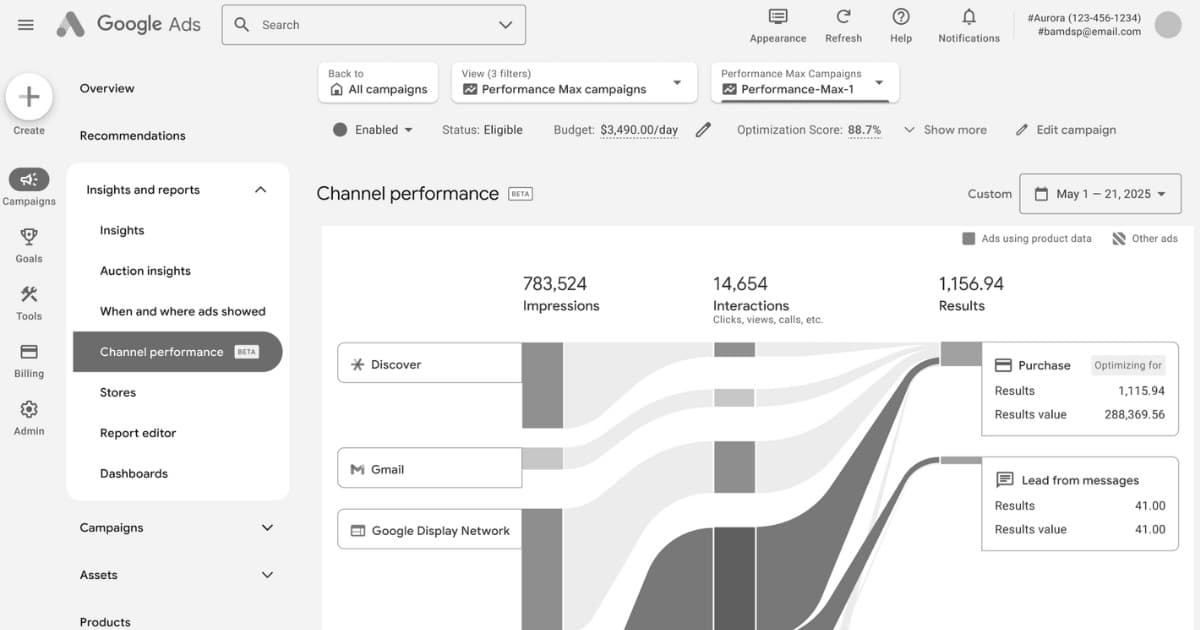
Channel-Level Performance Reporting
- Data for Search, YouTube, Display, Discover, Gmail, Maps.
- Clicks, conversions, costs by channel now visible.
- Breakdown of PMax placement distribution—until now completely obscured.
Asset Performance Reporting
- Asset-level impressions, clicks, and cost data.
- See what creative is pulling weight, not just what’s running.
- Offers a basis for iterative testing and tighter message control.
Diagnostic Tooling
- Highlights friction points like underperforming landing pages or missing store locations.
Why It Matters – The Real Battle is Optics
Performance Max wasn’t suffering from lack of adoption—it was suffering from a trust deficit.
Despite a 93% usage rate among advertisers surveyed by Tinuiti, spend dropped from 69% to 53% quarter over quarter. That’s not because it couldn’t scale—it’s because advertisers couldn’t see or steer what was happening.
And the numbers confirm the slide:
- Conversion rates are 10% lower than standard search
- CPCs are 13% higher
- ROAS is down 7%
When performance drops and transparency evaporates, advertisers revert to the campaigns where levers still exist—even if they’re less “smart.” This update doesn’t restore control. But it does show receipts.
And sometimes, a glimpse is all it takes to keep the test running.
Why They Caved – Google Wasn’t The Fastest Growing Search Engine Anymore
Let’s start with the obvious: Bing didn’t suddenly become better. Google just became unbearable.
When you build a platform where ad costs skyrocket, data disappears, and “performance” is just trust-the-machine energy, advertisers do what they have to do: diversify.
And that’s exactly what’s happening.
- Microsoft Ads grew 17% YoY—nearly double Google’s 9%
- CPCs are up across the board—especially on branded terms
- Marketers are reallocating—not in protest, but in self-preservation
Here’s why:
Bing Didn’t Beat Google on Features—They Beat Them to the Feeling
We don’t have hard proof that Bing’s YoY growth was driven by its early integration of ChatGPT into search. But timing lines up. For the first time in a decade, Bing felt new—maybe even cooler.
When GPT-style answers started showing up in Bing’s SERP before Google had Gemini live and visible, the shift wasn’t just technical—it was emotional. Suddenly, Bing didn’t look like the bargain-bin search engine. It looked like the one willing to try something new.
Was it better? Not really.
Did it pull massive market share? Also no.
But for a subset of advertisers—especially those already disillusioned by rising CPCs and vanishing transparency—it was enough of a spark to test.
And here’s the trick: Bing doesn’t need mass migration to post big growth.
When your baseline is small, a few major advertisers testing the waters creates real movement. And in an ecosystem starved for control and clarity, “less bad” starts to feel like innovation.
The PE Arms Race Is Driving Google CPCs Off a Cliff
In market after market, PE-backed home service companies are bidding like the goal is to win an auction—not a business. When cost-per-click is treated like a sunk cost to buy growth at any price, it inflates the auction floor for everyone. Google’s scale makes it the battlefield of choice for these aggressive spenders—and everyone else is left trying to compete with a blank check.
That pressure doesn’t just make Google more expensive. It makes it less sustainable. Bing becomes the refuge for marketers trying to hit real ROAS goals instead of vanity market share.
The Takeaway: Bing Didn’t Win—Google Fumbled
When costs go up and control goes down, even a slightly worse option starts to look like a smart hedge. That’s what Bing is now: not the hero, but the escape hatch. And Google knows it.
The Performance Max transparency push? The AI Max beta? They’re not innovations. They’re damage control. Moves to keep budget locked in before the narrative slips any further.
So How Do You Make It Work for You?
Google didn’t hand over control—but they did hand over clues. If you know how to read them, these updates give you just enough leverage to start shaping PMax outcomes in your favor.
So how do you actually use this data when the levers are still limited? Here’s how strategic marketers are making PMax work for them.
1. Use Search Terms to Block Time-Wasters
You can finally see what PMax is pulling in—and some of it’s going to be junk.
Look for terms like:
“DIY,” “cheap,” “free,” “budget,” or “how to fix.”
These aren’t buyers. They’re browsers.
Block them with negative keywords before they chew through your prospecting budget.
This is your first real chance to filter intent, not just demographics. Use it.
2. Stop Brand Bleed with a Brand Exclusion List
PMax will happily take credit for conversions from people already looking for you. That’s brand bleed—and it inflates your metrics without adding real demand.
Apply a brand exclusion list to keep branded queries out of your PMax mix.
That means:
No conquesting your own name
No inflated ROAS from low-effort clicks
No overlap with your Search or Shopping campaigns
Want to know if PMax is doing its job? Take your name off the jersey and see if it still plays.
3. Prioritize High-Value Leads with Target ROAS + Marketing Pro Ads
Here’s where you force the machine to go from volume to value.
Set up conversion value tracking in Marketing Pro Ads, and set JVP conversion actions as the primary value conversions—the ones predicted to convert today, not someday.
Then run an experiment with a Target ROAS bid strategy.
You’re telling PMax:
Don’t just bring leads. Bring leads that spend. And bring them now.
This is the difference between feeding the funnel and growing revenue.
4. Follow the Channel-Level Breadcrumbs
The PMax blend is no longer a mystery smoothie. You can now see exactly where your budget’s landing: Search, YouTube, Display, Discover, Gmail, Maps.
Here’s the play:
Double down where the results are clean
Break out strong performers into standalone campaigns
Cut or cap what isn’t delivering
Let PMax surface what’s working—then pull those channels into your own optimized system.
5. Use Asset Data to Sharpen Your Message
Now that you can see which assets are driving impressions, clicks, and cost, there’s no excuse for lazy creative.
Kill the dead weight
Iterate based on real engagement
Align your messaging to what the market is actually responding to—not just what the AI runs
Creative testing inside PMax just became real strategy—not just decoration.
The Bottom Line: The Black Box Didn’t Disappear—It Got a Window
This isn’t a gift. It’s a calculated play to keep advertisers in the machine just a little longer.
PMax still offers limited control—but now you can see what’s working, what’s wasting spend, and where your budget is actually going. For performance-minded marketers, that’s enough visibility to start steering smarter.
You may not have the wheel—but you’ve got the map, the gauges, and a little more say in the route.
Get it in your inbox, every Friday.
2,000+ trades owners already read it. Unsubscribe any time. @freeagency.ai on TikTok
Keep reading
More plays
UPDATED: ChatGPT Ads Manager Now Available For Local Services (May 2026)
On Friday, OpenAI quietly shipped state, DMA, and ZIP code geo targeting in the ChatGPT Ads Manager.
Read the play
How to Critique an SEO Report When the Graph Is Always Green
You’re in the quarterly review. Every chart is green, every arrow up, and your booked jobs are flat.
Read the play
New Study Correlates LLM Ranking Heavily With SERP Ranking. Is AEO Just SEO?
You saw the post on Facebook. An industry marketer you’ve followed for a while was announcing their proprietary AI Visibility Engine.
Read the play