Calls showing up as spam? My client put a name on theirs and more than doubled their conversation rate.
 Cory CullatherChief Marketing Officer
5min read

Contents
Your team is calling people who asked for a call, and almost none of them pick up. From inside the office it looks like a lead quality problem. On the customer’s phone it looks like a number they’ve never seen, or worse, a number with a spam warning stuck to it.
One of my clients, a home-service company, just turned on branded caller ID through Hiya. The customer’s screen now shows the business name where a bare ten-digit number used to be. The share of outbound calls that became a real conversation went from 3.7% to 9.4%.
Here are the numbers, why I think they moved, and the exact steps to stop your own calls showing up as spam or as nobody.
Two problems that look identical from the office
Calls showing up as spam and calls showing up as a stranger are different problems. Both produce the same report: lots of dials, no conversations.
The first is a label. Carriers and the analytics companies behind them score outbound numbers and attach warnings like “Scam Likely,” “Spam Risk,” or “Potential Spam.” A legitimate business can earn one from high call volume, short calls, poor answer rate, or a recycled number with someone else’s history on it.
The second is anonymity. Your number isn’t marked as spam, but it still rings as ten digits with no name. Hiya’s State of the Call 2026 report found that 86% of consumers say they won’t answer an unidentified call. That’s a survey of more than 12,000 consumers published by a company that sells the fix, so weigh it accordingly. It also matches what my own thumb does.
Registering your numbers with the major operators, like you can do with Free Caller Registry or Hiya Number Registration, can help reduce the likelihood of your calls being marked as spam. For the problem of anonymity, you can use call branding. Most shops need both, in that order.
What happened when we branded the calls
| Measure | Before go-live | After go-live | Change |
|---|---|---|---|
| Outbound calls that became a real conversation (60+ sec) | 3.7% | 9.4% | About 2.5x |
| Calls rejected as “Busy” | 4.7% | 2.0% | Down about 60% |
| Meta leads reached within 24 hours | 18% | 29% | Up 11 points |
A “real conversation” is a connected call that lasts 60 seconds or longer. I use that instead of answer rate because a voicemail greeting and a four-second hang-up can both log as answered.
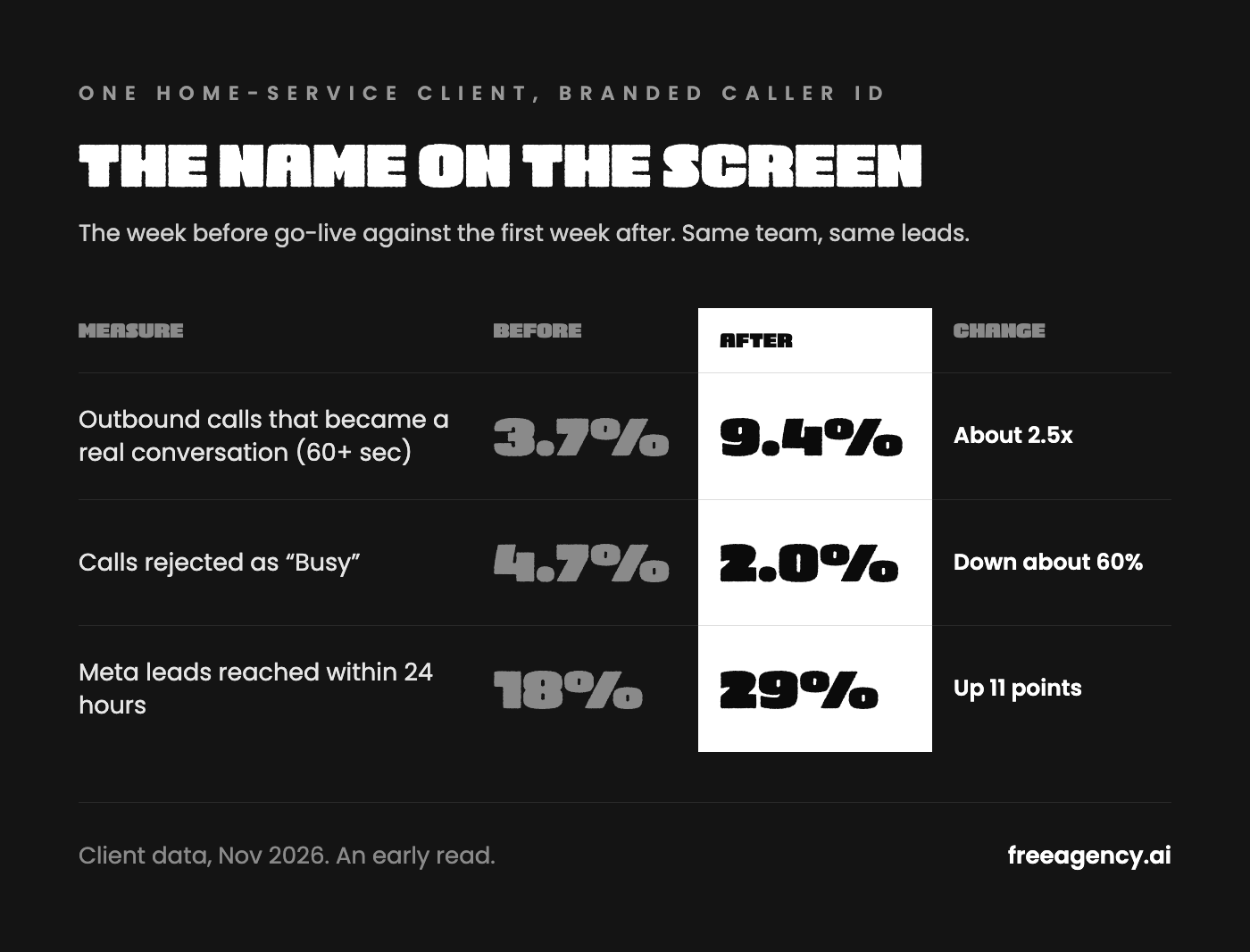
The daily counts moved the same way. Real conversations per day more than doubled. People calling back in rose about 80%. Booked jobs from Facebook and CSE leads rose about 53%, and sales appointments rose about 50%. The team did it on about the same number of dials. Same dialing, more talking.
The change was the name on the screen. Same team, same leads.
Why a name on the screen changes the math
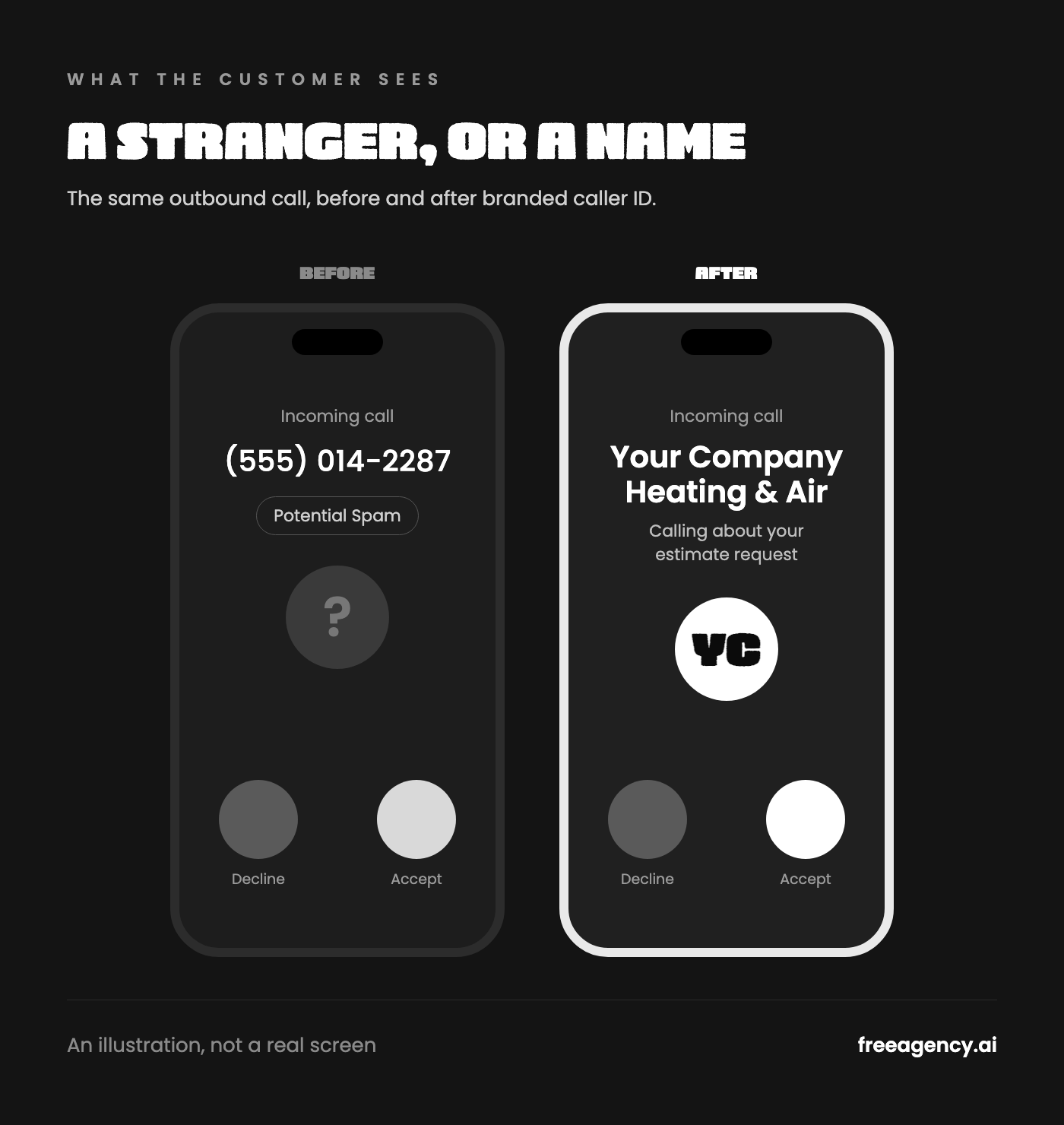
The customer decides whether to answer using whatever is on the screen. A bare number gives them nothing to decide with, so they decide no.
Two lines in the data fit that. “Busy” results fell from 4.7% to 2.0%. My read is that a lot of those were people hitting decline on a number they didn’t recognize, though the report can’t prove it. And callbacks went up, which is what I’d expect when a missed call shows a company name the customer remembers filling out a form for.
The old way to attach a name is CNAM, which Hiya describes as a 15-character field that works on landlines and runs on outdated databases. Branded calling runs at the carrier level. You register your numbers, specify a display name, and the customer’s carrier shows them on phones that support it. According to Hiya’s Branded Call page, there’s nothing to integrate with your dialer.
How to connect with your customers
- Find out what customers see. Call a Verizon phone, a T-Mobile phone, and an AT&T phone from every number your team dials out on. Screenshot each one. You’re looking for a warning label, a bare number, or your name. For companies making over 5,000 monthly calls, you can sign up for a free call inspection from Hiya to run this automatically.
- List every outbound number. Include the local-presence pool and whatever your texting or follow-up platform calls from. Miss one and it keeps ringing as a stranger.
- The numbers are registered automatically, for free. The Free Caller Registry submits your numbers to Hiya, First Orion, and TNS, the analytics companies behind the major carriers, in one form. ServiceTitan recommends the same step for its own outbound calling. Hiya’s Number Registration is also free and shows whether a number is carrying a spam label today.
- Add branding. In Hiya, set the display name, logo, and call reason. Hiya allows up to 32 characters for the name. Use the name on the truck, not the LLC.
- Wait, then test again. Hiya says branding typically goes live within a few hours to a couple of days. Repeat step one and compare screenshots.
Write down your baseline first and freeze everything else. Pull two weeks of conversation rate, callbacks, and booked jobs before you start, and don’t change scripts or cadence during the test. One variable at a time, or you’re guessing.
On cost: Hiya sells monthly plans and a pay-as-you-go option, charges for branded calls delivered, adds a one-time setup fee, and lets self-serve plans cancel anytime. Check current pricing yourself, since it varies by country. Hiya is not the only vendor in the category. First Orion and TNS sell it too.
Free Agency takes no referral fees from vendors, Hiya included.
What I’m still watching
This is an early read: the first week after go-live against the stretch right before it. The direction is clear. The size of the lift will settle as the weeks stack up, and I want to see it hold across matching days of the week.
Coverage is partial. Hiya’s own US list names Verizon and T-Mobile, plus Samsung phones bought without a carrier lock. AT&T is not on it. So some share of these calls still rang without the brand, and anyone evaluating a vendor should ask about AT&T first.
Booked is not sold. The number that settles this is sold revenue out of ServiceTitan by lead source, set against the Hiya invoice.
And 29% of Meta leads reached within 24 hours means about seven in ten still weren’t. Branding moved that number. It didn’t fix it.
What branding won’t fix
It won’t fix a dialing pattern customers hate. Hiya says plainly that branding lowers the odds of a spam label and doesn’t guarantee protection, because carriers also weigh consumer feedback.
It won’t fix speed either. A branded call placed a day late is still a day late.
You already paid for the lead. The least you can do is tell them who’s calling.
A Free Agency CMO: embedded as the marketing leader inside a client's business, building the plan and running every partner, channel and budget line against it. Holds the Free Agency CMO certification.
Get it in your inbox, every Friday.
2,000+ trades owners already read it. Unsubscribe any time. @freeagency.ai on TikTok
Keep reading
More plays
Why your revenue problem probably isn’t a marketing problem
A client asked us last week if it was normal to spend 30 percent of gross profit on marketing.
 Brett HansenRead the play
Paid social creative for home services: The hyperlocal video playbook
Most home service companies are paying Meta to show the same AI ads to every homeowner inside a 20-mile radius.
 Amanda DanfordRead the play

Residential is up 43%
Anchor Pest Control set out to grow residential, the side of the business where the recurring revenue lives.
 Dee OlenickRead the play