
Paid social creative for home services: The hyperlocal video playbook
 Amanda DanfordChief Marketing Officer
11min read
Contents
- Why hyperlocal paid social creative for home services gets a response
- The six-step hyperlocal paid social video process
- How to film multiple cities without losing an entire day
- Production quality guidelines for paid social videos
- Common mistakes that make community targeting fail
- Local does not mean small
- The next paid social test to run
Most home service companies are paying Meta to show the same AI ads to every homeowner inside a 20-mile radius.
Your competitor is doing the same thing.
The homeowner sees two trucks, two tune-up offers, and no real reason to remember either company.
The audience may be correct. The offer may be competitive. None of it gets a chance to stand out when the ad could have come from any HVAC, plumbing, or electrical company in the country.
The fix is community targeting.
Community targeting pairs city-specific creative with city-specific media targeting. It is paid social creative for home services built one town at a time. The homeowner hears the name of the town, sees a landmark they recognize, and watches real work performed by a company that clearly serves the area.
This is not a theory we built from engagement metrics.
In June, one established HVAC, plumbing, and electrical company spent $11,868 on paid social. The campaigns generated 266 leads, 108 new jobs, and $109,612 in completed job revenue.
Here is the math:
- $44.62 per lead - $109.89 per new job - 40.6% of leads converted into new jobs - $9.24 in completed job revenue for every $1 of ad spend
That is one company in one month, in peak cooling season. Read it as a result, not a forecast.
The targeting mattered. The offer mattered. The follow-up mattered.
But the creative had to earn the first two seconds.
Why hyperlocal paid social creative for home services gets a response
Homeowners do not open Facebook hoping to watch an HVAC ad.
They are looking at family photos, neighborhood arguments, and sports clips. Your ad is an interruption, so it needs to give the right person a reason to stop.
Recognition buys you time
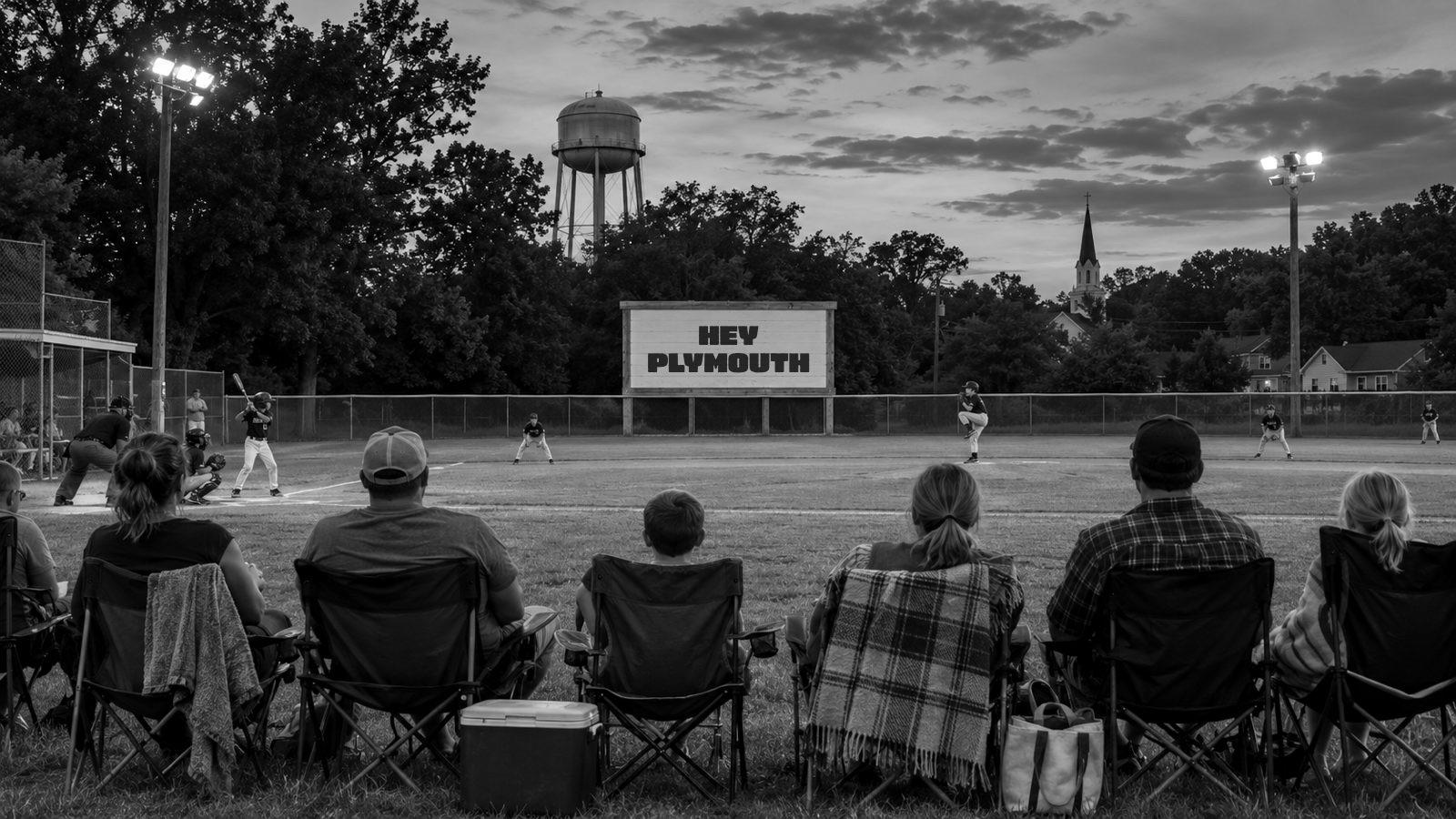
A homeowner in Plymouth may scroll past another generic “$49 tune-up” ad. The same homeowner is more likely to pause when the first line is “Hey Plymouth” and Plymouth Rock is visible behind the technician.
That pause gives the company time to communicate the offer and next step.
Local proof answers the first objection
A homeowner considering a service company wants to know whether you actually work in the area.
A city callout answers that directly. The landmark adds visual proof. A branded truck makes the company identifiable.
You are not asking the homeowner to search your service map or trust a tiny location pin in the caption. The answer is inside the ad.
Real footage reduces the trust gap
Trades advertising has a trust problem.
Homeowners have seen stock photos, fake urgency, and lead aggregators dressed up as local contractors. Real technicians, trucks, and service footage help separate your company from that mess.
The ad does not need to look expensive. It needs to look true.
The six-step hyperlocal paid social video process
Your team handles the first five steps. Your agency handles the campaign mechanics.
Step 1: Pick the cities and ZIP codes you want to win
Do not start with your entire service area.
Start with three to five geographic clusters where more demand would help the business.
#### Use operating data, not a map
Choose markets based on:
- Average ticket - Technician capacity and drive time - Demand - Market share
A city is not valuable because it sits inside your radius. It is valuable because the work fits your business. Not sure where you stand? Run your market share by ZIP first.
#### Define the exact ZIP codes
For a South Shore Massachusetts example, the initial clusters might look like this:
- Plymouth: 02360 - Weymouth: 02188, 02189, 02190, 02191 - Quincy: 02169, 02170, 02171
Check every ZIP before it goes into the ad set. Plymouth’s 02361 and 02362 are PO Box codes, and 02367 is Plympton, a different town. Plympton will not appreciate being called Plymouth.
The creative and the audience need to match. A “Hey Plymouth” ad should not be delivered across the entire state.
One limit to know: Meta only targets people “living in or recently in” a location, so you cannot restrict delivery to residents. Saying the city name out loud is one of the few filters you still control.
To narrow the audience further, target homeowners by home age on Meta via third-party audiences.
#### Do not hide behind broad service language
“Proudly serving the South Shore and surrounding areas” may be accurate.
It is also easy to ignore.
Pick a place. Say the name.
Step 2: Find a landmark locals recognize
Every market has a visual shortcut.
Plymouth has Plymouth Rock. Quincy has Marina Bay. Weymouth has Weymouth Landing.
Look for city signs, downtown districts, parks, marinas, murals, historic buildings, or recognizable local businesses with permission. New to the area? Ask a technician, or read the local Facebook group for ten minutes.
#### Pick recognition over beauty
The prettiest background is not always the best one.
Choose the place a local identifies in one second. The landmark is there to create recognition, not win a tourism award.
Make sure the location is safe, legal to film, and quiet enough to record usable audio.
Obligatory disclaimer: Plymouth Rock sits in a state park, and Massachusetts requires a permit for professional photo and video shoots on state park property. Ask first. (Or do it at your own risk.)
Step 3: Film the city-specific opening
Stand in front of the landmark. Put the wrapped vehicle in frame when possible.
Then say the city name.
“Hey Plymouth.”
“Quincy homeowners.”
“Weymouth, this one is for you.”
That is the clip.
#### Say the city immediately
Do not spend eight seconds introducing yourself before naming the market. The city callout belongs in the first sentence.
Keep the opening between 5 and 10 seconds.
#### Record three natural takes
The first take gets the nerves out. The next two give the editor options. Do not spend 20 minutes trying to make one take perfect.
Talk like you would in a homeowner’s driveway. Do not memorize a corporate paragraph. A trades owner who sounds like a real person is more believable than a trades owner doing an impression of a spokesperson.
Clear beats polished. Human beats perfect.
Step 4: Record one offer and one reason to act
The next clip explains what you want the homeowner to do.
Use this structure:
City + offer + timing + next step.
For example:
“Just for America’s Hometown, we’re offering a $49 tune-up just for you guys to help you now that the weather is warming up.”
The offer is clear and the timing makes sense. Then give the next step. Tell the homeowner to call, book online, request an estimate, or submit the form. Do not make people guess.
#### Keep the message narrow
Choose one offer, such as a seasonal tune-up, same-day appointment, drain-clearing special, electrical inspection, replacement estimate, or membership.
A 20-second ad cannot carry your entire service catalog, company history, awards, financing terms, and three guarantees. Pick the message most likely to create the next action.
Step 5: Capture real service B-roll
The city callout earns attention. The service footage helps earn trust.
Record the work your team already does, especially the work related to your offer.
Useful clips include the truck arriving, the technician greeting the customer, inspections, tools in use, clean installations, before-and-after footage, and the finished system running.
Film each shot for 5 to 8 seconds. Hold the phone steady. Get more than one angle. Do not swing the phone around the mechanical room.
Ask the homeowner before you film in or around the house, and keep house numbers out of frame.
A finished 15-to-30-second video may use six to ten short clips. Three seconds of shaky B-roll is not enough. Give the editor options across different technicians, job types, homes, and angles.
Real work is the asset. Capture it.
Step 6: Send the footage to your agency
Once the clips are recorded, send the raw files to your agency. (Our preferred partners include video editing in their management fee.)
Do not edit them together. Do not add music. Do not place captions over the footage. Do not compress the files by texting them one at a time.
Label the files like an adult. “Plymouth opening take 1” tells the editor what it is. “IMG_8472” tells the editor nothing.
The agency, or the AI, handles editing, subtitles, offer graphics, city-specific versions, audience segmentation, campaign setup, testing, tracking, and reporting.
If you are DIYing it, throw the footage at an AI editor. OpusClip will cut, caption, and reframe raw talking-to-camera clips, and you can direct the edit in plain English from inside Claude.
Your team provides the part neither one can manufacture: real people, real local knowledge, and real work. The AI is good at captions. It does not know where Weymouth Landing is.
How to film multiple cities without losing an entire day
Owners hear “city-specific creative” and picture a week-long production. That is not the process.
Most of the footage can be reused. Only the city opening and landmark shot need to change.
A workable filming day could look like this:
- Forty-five minutes at the shop for the reusable clips: the main offer, the reason to choose the company, the call to action, technician introductions, and truck shots.
- Sixty to ninety minutes at an active job for service B-roll.
- Three nearby landmark stops at about 10 minutes each. Park the truck, frame the landmark, record three city callouts and one optional city-specific offer, and move on.
- One upload session.
You do not need to film a full commercial at every location. The editor pairs the reusable clips with each city-specific opening, and that is enough material for several city-specific ads and multiple editing variations.
Production quality guidelines for paid social videos
You do not need expensive equipment. You need footage that can be heard, seen, and edited.
Film vertically
Record in a 9:16 vertical format. Meta’s own guidance recommends 9:16 for Stories and Reels because most people hold their phones vertically.
Horizontal footage creates dead space or forces the editor to crop out useful details.
Clean your lens
Wipe the camera lens before recording.
This takes five seconds. It prevents the entire shoot from looking like it happened inside a steam room.
Get close enough to hear, or use a mic
Audio problems ruin more footage than camera quality does.
Stand close to the phone. Avoid heavy wind and traffic. Play back one clip before leaving the location.
Leave space before and after the line
Press record. Wait one second. Say the line. Wait one second. Stop.
Those pauses give the editor clean cut points.
Common mistakes that make community targeting fail
The strategy is simple. Execution still matters.
Trying to cover every market in one video
One ad for 30 cities creates broad language and weak recognition.
Making the landmark the entire idea
The landmark gets the pause. The offer creates the response.
Overproducing the creative
Heavy scripting, stock footage, and glossy production can remove the credibility you were trying to create.
Clean is good. Corporate is not.
Launching without a follow-up plan
Creative generates the lead. Your operation converts it.
Before increasing spend, know who receives the lead, how quickly the first call happens, how many contact attempts are made, and whether jobs and completed revenue are tied back to the source.
How quickly means a minute. Not an hour. A Velocify study of 3.5 million leads found prospects called within one minute were 391% more likely to convert than those called later. It is a 2012 vendor study and not specific to the trades. Nobody has published one saying slower is better.
A $44 lead that nobody calls is not a $44 lead. It is wasted money.
Measuring only cost per lead
Paid social performance is often reduced to cost per lead. That number matters, but it does not tell you whether the campaign produced work. It can also hide calls that were never leads.
Consider two campaigns with the same $2,000 in spend:
| Campaign A | Campaign B | |
|---|---|---|
| Leads | 40 | 25 |
| New jobs | 5 | 10 |
| Cost per lead | $50 | $80 |
| Cost per new job | $400 | $200 |
Campaign B has the higher cost per lead. It also produced twice the work.
The stronger view is:
- Ad spend divided by leads equals cost per lead. - Ad spend divided by new jobs equals cost per new job. - New jobs divided by leads equals booking rate. - Completed revenue divided by ad spend equals ROAS.
Use completed revenue. Those are operating numbers. Likes are not.
In ServiceTitan, that only works if every lead lands on a campaign. Send Meta lead forms into the Bookings tab with a Zap so each booking carries its campaign. Tag every link back to your site with UTMs so calls and web bookings land on that same campaign. Use one campaign per city if you want the numbers by market.
That is how you keep media reporting connected to the P&L.
Local does not mean small
Community targeting is not limited to owner-operated shops with one truck.
Regional companies need it more.
A company may serve 40 cities. The homeowner still lives in one.
The truck stays the same. The team stays the same. The service standards stay the same. The city opening, landmark, offer, and audience change.
That structure allows a regional company to create local relevance without rebuilding the campaign from zero for every market.
Track leads, new jobs, and completed revenue by market. Move budget toward the markets producing profitable work, then add the next group of cities.
Scale comes from repeating what works. It does not come from making the first audience as large as possible.
The next paid social test to run
Pick one city where you want more work.
One landmark. Three takes of the city callout. One offer. At least five useful service clips.
Send the raw footage to whoever runs your paid social, labeled by city and clip type, and hold them to three numbers: leads, new jobs, and completed revenue.
Run that test before buying another month of generic creative that gives every homeowner the same reason to keep scrolling.
A Free Agency CMO: embedded as the marketing leader inside a client's business, building the plan and running every partner, channel and budget line against it. Holds the Free Agency CMO certification.
Get it in your inbox, every Friday.
2,000+ trades owners already read it. Unsubscribe any time. @freeagency.ai on TikTok
Keep reading
More plays
Calls showing up as spam? My client put a name on theirs and more than doubled their conversation rate.
Your team is calling people who asked for a call, and almost none of them pick up. From inside the office it looks like a lead quality problem.
 Cory CullatherRead the play

Why your revenue problem probably isn’t a marketing problem
A client asked us last week if it was normal to spend 30 percent of gross profit on marketing.
 Brett HansenRead the play

Residential is up 43%
Anchor Pest Control set out to grow residential, the side of the business where the recurring revenue lives.
 Dee OlenickRead the play