
Why your revenue problem probably isn’t a marketing problem
 Brett HansenChief Marketing Officer
6min read

Contents
A client asked us last week if it was normal to spend 30 percent of gross profit on marketing. It’s not. Gross profit is the wrong yardstick: depending on your margins, 30 percent of gross profit can land well under or well over a healthy budget. For an established shop pushing growth, the number we usually work toward is 8 to 12 percent of revenue goal, not 30 percent of whatever profit happened to land that month. The right number moves with how old the company is and how hard it’s growing, but that’s the range. Across the accounts Free Agency manages, marketing spend has run about 9 percent of client revenue since 2024.
But the percentage wasn’t the interesting part of that call. What came after it was, and it’s the part that matters to any owner staring at leads not converting into revenue.
Marketing and revenue are not the same job
For most of what a trades company sells, marketing doesn’t create demand. The demand already exists, the water heater already failed, the AC already died. Marketing’s job is to put your business in front of that demand before someone else does, capture it, and hand it to sales as a lead. Some of those leads are great, some aren’t, but the job is to feed the schedule with enough of them to keep everyone busy.
And yes, if the board is empty, we can “create” work with proactive tune-up specials. That’s work, not demand. Most of our job is demand capture and the efficiency of it.
What happens to a lead after that point is operational, and it’s out of marketing’s hands. So when a company has plenty of leads coming in but revenue isn’t keeping up, the problem usually lives somewhere between the lead and the closed job. Not in the ad account.
Leads not converting? The funnel tells you where to look
Marketing → leads → booked calls → showed calls → estimates → closed jobs → revenue
Follow that line and you can usually point to exactly where the leak is:
- Lead response time. Nobody calls the lead fast enough. In a Harvard Business Review study of 1.25 million sales leads, firms that tried to reach a lead within an hour were nearly seven times as likely to qualify it as firms that waited one hour longer. That study is from 2011 and wasn’t built on trades companies, so treat it as direction, not a benchmark. - Abandon rate. Who is hanging up before you even answer? - Booking rate. The CSR doesn’t turn an inquiry into an appointment. - Run rate. The appointment gets made and never runs: a cancellation, nobody home, a reschedule that never rebooks. - Options presented. The tech or comfort advisor isn’t putting enough options in front of the customer. - Average ticket. Jobs are getting sold at a lower value than they should. - Follow-up. Unsold estimates never get worked a second time. - Capacity. The company is generating more demand than it can actually service. Cancellation rate usually tells you. - Lead quality. This one can be marketing’s fault. You need evidence from the calls themselves before you assume it is. But a lead is someone in your service area asking for a service you provide, not someone with an open wallet begging for a $30K duct renovation.
Same leads, two different outcomes
Picture two HVAC companies, each getting 1,000 leads in a month, same $1,500 average ticket.
Company A 700 booked, 600 showed, 300 sold. $450,000 revenue.
Company B 500 booked, 400 showed, 120 sold. $180,000 revenue.
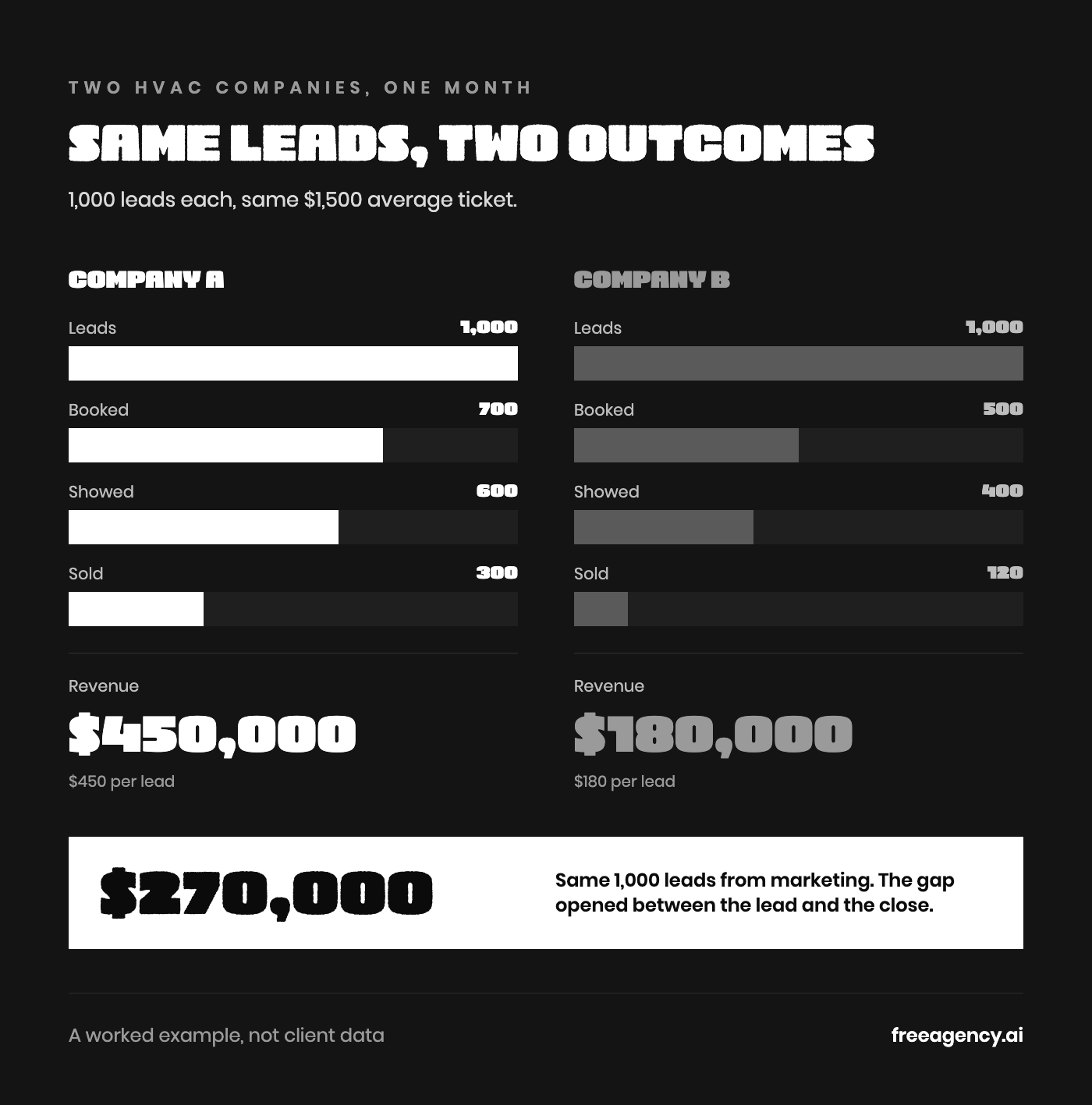
Marketing generated the exact same 1,000 leads for both. That’s $450 of revenue per lead at Company A and $180 at Company B. Company B has a $270,000 revenue problem. It does not automatically have a marketing problem, and the only way to know for sure is to look at what happened between the lead and the close.
We’ve run the longer version of this math, what weaker operations do to ROAS on the same marketing, if you want to see it across a full year.
If a client says marketing isn’t working because revenue is down, the first question is always the same: what happens to the lead after it comes in.
What that actually looks like
What’s the phone system doing? Is it routing calls through a tree that loses people before a human ever answers, and what’s the abandon rate on inbound calls? One thing to know before you blame the phone tree: in ServiceTitan, the Abandoned bucket also holds calls a CSR answered without clicking the call bubble. Pull the list and see which kind you have.
Are CSRs trained to handle objections, or are they built for customer care instead of booking? A booking rate under 50 percent isn’t acceptable, and before another dollar goes to marketing, that’s the number to fix, ideally with call listening software that pulls out coaching moments without someone burning an hour to review three calls. Are you measuring why calls are excused or unbooked, and fixing that?
To be clear on the math, that’s booked jobs over real lead calls, the way ServiceTitan counts it, not booked jobs over every ring. And under 50 isn’t rare. When ServiceTitan pulled booking rates across more than 3,000 shops in 2022, the typical shop booked 42 percent, and shops with 25 or more techs averaged 59.
But a 90 percent booking rate can be just as fake. We broke down how that happens, and the short version is that the rate only scores the callers who made it into the count. An answered call that ends inside 60 seconds with nothing booked gets excused automatically. A ring nobody picked up files as abandoned. Sloppy call reasons and reclassified calls pull more real demand out of the math. A great team on a tight service area can earn a real 90, but a near-perfect number is also exactly what over-excusing produces. Pull 20 recordings from the excused pile, start with the one-to-three-minute calls, and ask one question of each: in our area, for something we do?
How fast are people actually getting scheduled, and is the calendar so packed five days out that emergency calls are getting lost? Are estimates getting a second and third follow-up, or dying in an inbox?
How to diagnose it instead of guessing
Walk the numbers in order: cost per lead, lead-to-book rate, run rate, close rate, average ticket, revenue per lead, gross profit per lead. When the complaint is leads not converting, that sequence shows exactly where the economics break down instead of everyone pointing at the marketing budget by default.
The short version we use: cost per lead up with booking rate holding is a marketing problem. Cost per lead normal with booking rate down is an operations problem.
Marketing can absolutely be the reason revenue is down, if lead volume, lead quality, targeting, or channel mix has slipped. That’s not the point being made here. The point is that a revenue number by itself doesn’t prove marketing caused it. You have to find the broken link, and in our experience, most of the time it isn’t sitting in the ad account.
A Free Agency CMO: embedded as the marketing leader inside a client's business, building the plan and running every partner, channel and budget line against it. Holds the Free Agency CMO certification.
Get it in your inbox, every Friday.
2,000+ trades owners already read it. Unsubscribe any time. @freeagency.ai on TikTok
Keep reading
More plays
Calls showing up as spam? My client put a name on theirs and more than doubled their conversation rate.
Your team is calling people who asked for a call, and almost none of them pick up. From inside the office it looks like a lead quality problem.
 Cory CullatherRead the play

Paid social creative for home services: The hyperlocal video playbook
Most home service companies are paying Meta to show the same AI ads to every homeowner inside a 20-mile radius.
 Amanda DanfordRead the play

Residential is up 43%
Anchor Pest Control set out to grow residential, the side of the business where the recurring revenue lives.
 Dee OlenickRead the play