UPDATED: ChatGPT Ads Manager Now Available For Local Services (May 2026)
 Bri SkiffingtonChief Executive Officer
Updated Jun 4, 2026
7min read
Contents
On Friday, OpenAI quietly shipped state, DMA, and ZIP code geo targeting in the ChatGPT Ads Manager. That was the missing piece. For the past two weeks, the platform’s only geographic option was country-level, which made it a national-brand surface with a self-serve UI. As of this weekend, it’s a working ad channel for a single-market HVAC, plumbing, or electrical business.
This is a fast-moving update on what just changed, what’s now possible, and the one real catch that should shape how you test in the next 30 days. We’ll keep updating it as we get hands-on time inside live campaigns.
What just changed this weekend
Three updates landed inside the Ads Manager Beta on Friday.
Geographic targeting now supports U.S. state, designated market area (DMA), and ZIP code. ZIP-level targeting is sharper than what Google Ads offers most local advertisers by default, which typically operates on radius or city. For a service business that knows its top-performing ZIPs by ticket size or close rate, this is a meaningful unlock.
Daily and lifetime budgets are now live at the campaign level. Before this, advertisers had less control over pacing, which made small-scale tests harder to run. You can now set a $50 daily budget on a campaign and let it run.
List view totals in the Ads Manager now aggregate impressions, clicks, and spend across campaigns, ad groups, and ads. Small change, but it removes friction from day-to-day account management.
The combination is what matters. Granular geo, daily budgets, and rolling reporting are the three things you actually need to test a local channel without committing to a national-brand budget. Until Friday, none of them were there. As of this weekend, all three are.
What’s actually in the ChatGPT Ads Manager
The Ads Manager looks broadly like Google Ads, with one significant difference in how targeting works.
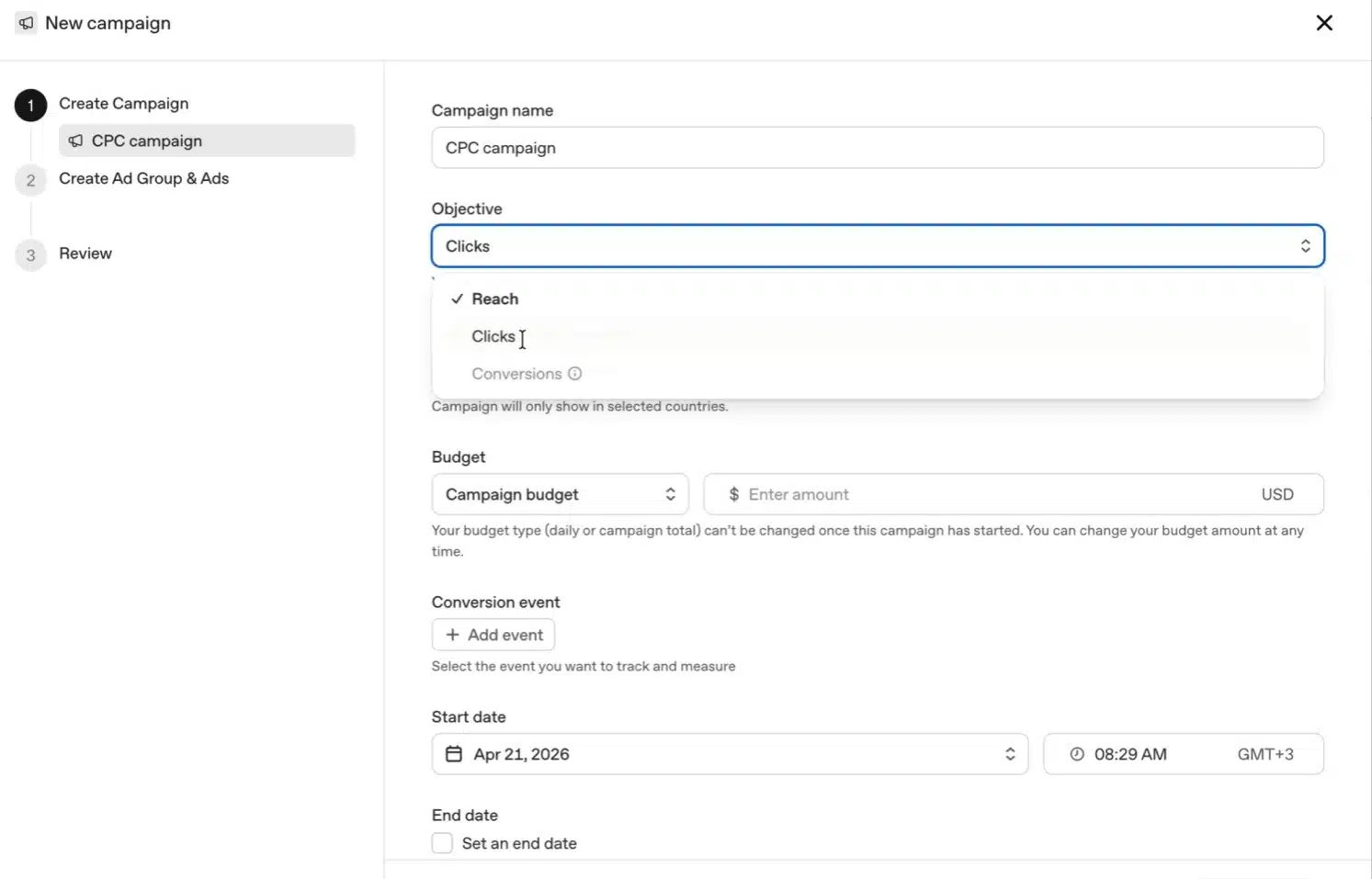
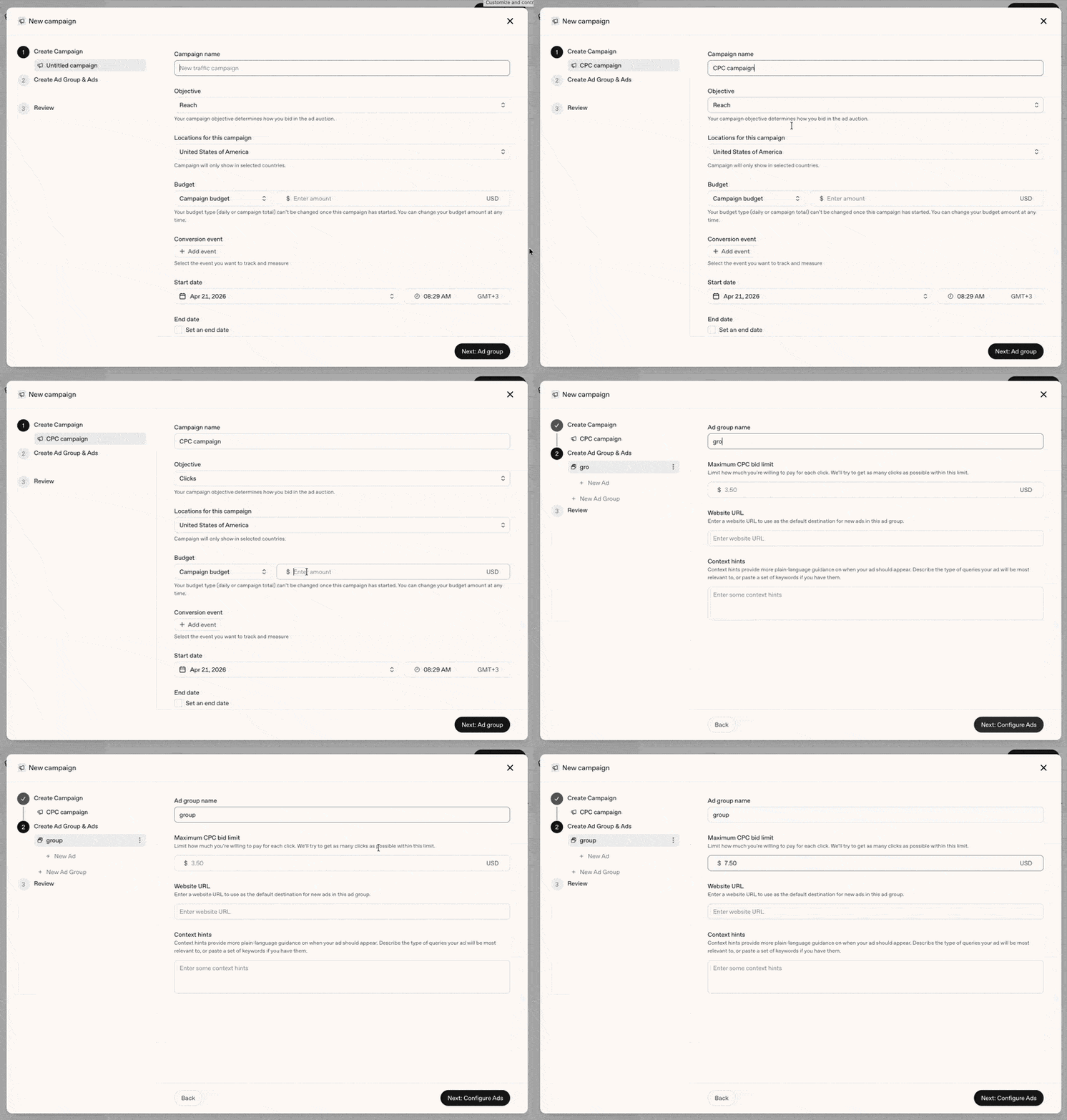
In late April 2026, digital marketers including Glenn Gabe and Juozas Kaziukėnas shared screenshots of the Ads Manager interface. What’s now publicly available matches those screenshots. A three-tier structure of campaigns, ad groups, and ads. Two campaign objectives currently active: Reach (CPM-based) and Clicks (CPC-based). Each ad unit is a small favicon plus a headline and description. Anyone who has run a Google Ads account would find their way around it on the first try.
The interesting part is how targeting works. Instead of keywords, advertisers write what OpenAI calls “context hints” at the ad group level. Plain-language descriptions of the conversations, topics, or keywords where their products or services may be relevant. The system matches those hints against the in-progress chat thread and decides whether to surface the ad.
Translated for trades: instead of bidding on “ac repair phoenix,” you describe the kind of conversation where your ad should run. Homeowner with a broken AC. Asking about emergency service. Comparing repair to replacement. That’s a different mental model than every search platform you’ve planned against, and it’s the same conceptual shift Google has been pulling into AI Mode over the past year.
What this means for local services right now
You can sign up. We did. As of this weekend, you can target a single ZIP code with a daily budget and a context-hint description of the conversations you want your ad in. The structural barrier that’s been there since February is gone.
The new constraint is conversion tracking, and it’s the one thing you need to think through before spending a dollar.
OpenAI launched a Conversions API and a server-side pixel as the primary measurement infrastructure. That’s the right long-term architecture, but it doesn’t yet have documented integrations with the tools trades operators actually use to track leads. There’s no published guide for connecting CallRail. No documented workflow with ServiceTitan’s dynamic number insertion or form scrapers. The conversion pixel itself is OpenAI-managed, which means they generate it based on what you’re trying to track and send it to you rather than letting you create your own. That’s deliberate on their part, and it’s a good privacy posture, but it slows down the pace at which the integration ecosystem catches up.
What you can do today is client-side conversion tracking through Google Tag Manager. Phone clicks and form submissions fire as conversions on the landing page, which gives you directional data on whether ChatGPT ad clicks are producing engaged visitors. What you cannot do today is connect those conversions back to actual booked jobs the way you would with CallRail’s call scoring, ServiceTitan’s customer record, or a proper post-call attribution stack.
That gap matters for one reason: ROAS reporting on ChatGPT ads in the first 30 days will be directional, not definitive. You’ll see clicks. You’ll see form submits and phone-click events. You won’t see which of those turned into booked appointments, what the average ticket was, or what your cost-per-job actually came out to.
The other things worth knowing if you’re sizing this up:
Inventory is still maturing. AdExchanger reported that even pilot advertisers with central budgets had trouble spending their commitments because ad fill rate is still building. Creative format is constrained to a single favicon-plus-text unit with no rich media or video. Reporting at the dashboard level is aggregated, not conversation-level. CPA bidding and third-party measurement were both promised at the May briefing with no published timeline.
The smart play right now
Verify your account, set up a small test, and instrument it as best you can. Don’t wait for perfect attribution.
The first move is account setup. Sign-up is free, takes about five minutes, and you’ll need an email, business information including your EIN, payment info, and a billing address. Verification takes a few days at the moment and demand on the platform is high right now, so timelines are stretching. The faster you’re in the queue, the faster you can start testing.
The second move is a small scoped test. We’d recommend a few hundred dollars per week as a ceiling for the first 30 days, targeted at your two or three highest-converting ZIPs, with context hints written tightly around your strongest service line. The point of this budget isn’t to drive measurable ROAS. The point is to learn the platform mechanics, see what kind of click volume your market actually produces, watch how the context-hint targeting performs, and have your account warmed up and instrumented when conversion tracking matures.
The third move is instrumentation. Set up GTM on your landing page if you haven’t already. Fire conversion events for phone clicks, form submissions, and chat widget opens. Add UTM parameters to your ChatGPT ad URLs so the traffic shows up cleanly in Google Analytics. None of this gives you the post-call attribution you’d get on Google Ads with a proper CallRail or ServiceTitan integration, but it gives you directional data and it puts you in position to swap in the real conversion infrastructure the moment OpenAI’s pixel ecosystem matures.
The fourth move is patience on the budget side. Don’t scale spend until your conversion tracking matches what you have on Google. Once OpenAI documents a CallRail integration or a ServiceTitan-compatible workflow, you’ll have the data to scale. Until then, the test budget is tuition, not media spend.
The structural shortcut to know: ChatGPT’s Ads Manager isn’t sophisticated yet. There’s no Smart Bidding. No Performance Max. No five layers of automation deciding where your money goes. That’s actually the gift right now. You can set this up yourself in an afternoon and not get out-platformed by a more experienced advertiser, because the platform itself isn’t running circles around anyone yet. That window won’t stay open forever, every paid search platform eventually gets sophisticated enough that DIY becomes a disadvantage, but for the next several months, the gap between a careful operator setting this up themselves and an agency running it on your behalf is small. The non-negotiable is conversion tracking. Run the platform yourself if you want, but instrument the data correctly or you’re not learning anything.
If anyone is selling you ChatGPT ads management for local services right now, the question to ask is what their conversion tracking workflow looks like. If they don’t have a clear answer, they’re learning on your dime. The signup is yours to do. You own the account regardless of who manages it later.
Free Agency is staying on the forefront of this. We’ll update this article as we get hands-on time inside live campaigns, as conversion tracking integrations land, as the inventory picture for local categories changes, and as best practices around context-hint targeting become clearer. We’re working on the CallRail and ServiceTitan instrumentation workflows internally now and will publish what we learn.
The conversational ad layer is real, and the conceptual shift is happening across every major platform at once. The reader who sets up the account today and runs a small, instrumented test in the next 30 days is the one with real data when the rest of the trades industry starts asking whether this channel actually works.
Every new ad channel looks like a land grab in year one. By year three, it’s just plumbing. Get your faucet on the wall now.
Get it in your inbox, every Friday.
2,000+ trades owners already read it. Unsubscribe any time. @freeagency.ai on TikTok
Keep reading
More plays
How to Critique an SEO Report When the Graph Is Always Green
You’re in the quarterly review. Every chart is green, every arrow up, and your booked jobs are flat.
Read the play
New Study Correlates LLM Ranking Heavily With SERP Ranking. Is AEO Just SEO?
You saw the post on Facebook. An industry marketer you’ve followed for a while was announcing their proprietary AI Visibility Engine.
Read the play
Competitor Conquesting in Google Ads: What Your Agency Won’t Tell You Before You Turn It On
It usually doesn’t come up in the big strategy presentation. It comes up three months in, on a call with your Google Ads specialist, almost casually.
Read the play